Instagram influencer marketing in India has evolved from a niche branding tactic into one of the most influential customer acquisition channels available to modern businesses. Over the last few years, brands have increasingly shifted marketing budgets away from traditional advertising and toward creator-led campaigns that deliver authentic engagement, measurable reach, and stronger consumer trust.
Today, consumers are exposed to thousands of advertisements every day. As a result, conventional advertising methods often struggle to capture attention and build credibility. Influencers bridge this gap by creating content that feels natural, relatable, and trustworthy. Instead of interrupting consumers with promotional messaging, creators integrate products and services into content that audiences actively choose to consume.
Before planning any creator collaboration, brands should first understand how influencer marketing in India has evolved into one of the most measurable digital marketing channels. Knowing how influencer campaigns are structured makes it easier to estimate budgets, compare creators, and choose the right campaign strategy for long-term growth.
This shift in consumer behavior has transformed influencer marketing into a multi-billion-rupee industry in India. From startups and direct-to-consumer brands to multinational corporations and publicly listed companies, businesses of all sizes are investing in influencer partnerships to drive awareness, engagement, and revenue growth.
One of the most common questions marketers ask before launching a campaign is: How much do Instagram influencers charge in India?
The answer is not straightforward because influencer pricing depends on a wide range of variables including audience size, engagement quality, content format, creator niche, campaign objectives, and usage rights. Two creators with identical follower counts may charge vastly different rates depending on their audience demographics and historical performance.
Understanding Instagram influencer rates is essential because pricing directly affects campaign profitability. Brands that understand creator pricing structures are better positioned to negotiate partnerships, optimize budgets, and maximize return on investment.
This comprehensive guide explains how Instagram influencer pricing works in India, what factors influence rates, how brands should evaluate creators, and what businesses can expect to pay in 2026.
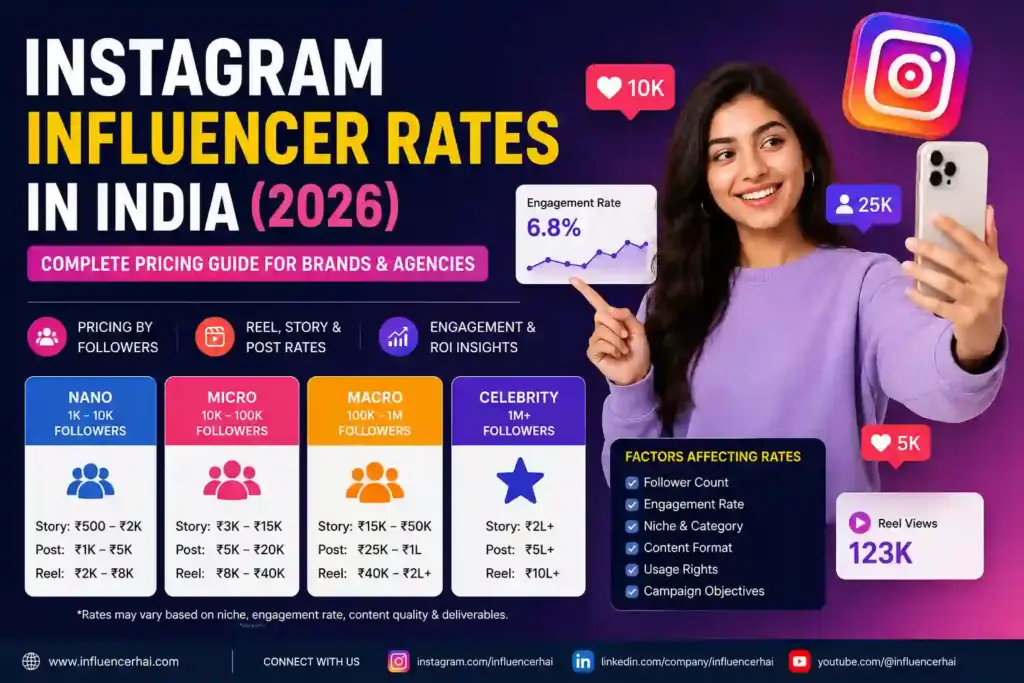
For businesses looking for a quick benchmark, Instagram influencer rates in India generally range from ₹500 for nano influencers to several lakhs for celebrity creators.
The following table provides a broad pricing overview.
| Influencer Category | Followers | Story Rate | Static Post Rate | Reel Rate |
|---|---|---|---|---|
| Nano Influencer | 1K–10K | ₹500–₹2,000 | ₹1,000–₹5,000 | ₹2,000–₹8,000 |
| Micro Influencer | 10K–100K | ₹3,000–₹15,000 | ₹5,000–₹20,000 | ₹8,000–₹40,000 |
| Macro Influencer | 100K–1M | ₹15,000–₹50,000 | ₹25,000–₹1,00,000 | ₹40,000–₹2,00,000+ |
| Celebrity Influencer | 1M+ | ₹2,00,000+ | ₹5,00,000+ | ₹10,00,000+ |
These figures should be treated as general market benchmarks rather than fixed pricing standards. Actual rates vary based on campaign requirements, creator reputation, engagement levels, content complexity, and industry vertical.
Brands should remember that influencer marketing is not simply about buying reach. The objective is to invest in creators who can influence purchasing decisions, generate meaningful engagement, and contribute to measurable business outcomes.
Pricing should never be evaluated in isolation. Businesses also need to understand the complete influencer marketing cost in India, including creator fees, campaign management, content licensing, paid amplification, and reporting. Looking at the full campaign cost rather than individual creator pricing helps brands make better investment decisions and improve overall campaign ROI.
The growing popularity of influencer marketing has created a situation where brands are eager to collaborate with creators but often lack clarity around pricing structures.
Unlike traditional media channels where advertising costs are standardized, influencer marketing operates within a dynamic marketplace. Pricing is determined by demand, audience value, niche specialization, and creator performance rather than a fixed rate card.
This creates uncertainty for many businesses, particularly startups and small companies that are planning their first influencer campaign.
Business owners frequently ask questions such as:
The purpose of understanding influencer pricing is not merely to reduce costs. It is to allocate resources more effectively and maximize campaign performance.
Companies that understand pricing frameworks can compare creators more accurately, negotiate confidently, and build scalable influencer marketing strategies.
To understand current pricing trends, it is important to understand how influencer marketing has evolved over the last decade.
In the early stages of social media marketing, influencer campaigns were largely dominated by celebrities and public figures. Brands primarily focused on visibility and associated themselves with well-known personalities to increase awareness.
As social media platforms matured, a new generation of creators emerged. These individuals built audiences around specific interests such as fashion, beauty, fitness, technology, finance, food, travel, and gaming.
Unlike celebrities, these creators often maintained closer relationships with their audiences. Their recommendations felt more authentic, leading to stronger engagement and higher trust levels.
This shift fundamentally changed influencer marketing.
Brands discovered that smaller creators could often generate better results than celebrities on a cost-per-engagement basis. As a result, influencer marketing expanded beyond awareness campaigns and became a performance-driven marketing channel.
Today, brands use influencer campaigns for:
The evolution of creator marketing has also influenced pricing structures, creating specialized categories that range from nano influencers to celebrity creators.
While follower count influences pricing, brands should compare creators based on engagement quality, audience demographics, niche authority, and previous campaign performance. This evaluation process helps marketers choose creators that deliver stronger business outcomes instead of simply selecting influencers with the largest audiences.
One of the biggest misconceptions in influencer marketing is that pricing is determined solely by follower count.
While audience size remains important, experienced marketers understand that influencer pricing is influenced by a combination of factors.
A creator with 50,000 highly engaged followers may provide significantly greater value than a creator with 500,000 inactive followers.
For this reason, brands must evaluate creators holistically rather than focusing on a single metric.
Audience size remains the most visible pricing factor.
Creators are typically categorized into four groups:
| Category | Followers |
|---|---|
| Nano Influencer | 1K–10K |
| Micro Influencer | 10K–100K |
| Macro Influencer | 100K–1M |
| Celebrity Influencer | 1M+ |
Larger audiences generally command higher rates because they provide broader reach.
However, audience size alone should never be used to determine campaign value.
Engagement rate is often considered one of the most important indicators of creator quality.
A highly engaged audience signals trust, relevance, and active community participation.
Brands typically evaluate:
Creators with stronger engagement often charge premium rates because their content generates better performance.
In many cases, engagement rate has a greater impact on campaign results than follower count itself.
The type of content requested significantly affects pricing.
Instagram stories, static posts, reels, carousel posts, live sessions, and long-term ambassador partnerships all require different levels of effort.
Instagram reels typically command the highest rates because they require:
Reels also receive higher organic reach compared to most other content formats.
This combination of effort and performance makes reels one of the most valuable influencer marketing assets available today.
Not all audiences carry the same commercial value.
Brands evaluate audience demographics to determine how relevant an influencer’s followers are to their target market.
Factors include:
Creators with highly targeted and commercially valuable audiences often command premium pricing regardless of follower count.
Certain niches generate higher rates because they attract audiences with stronger purchasing power.
Examples include:
| Premium Niches | Typical Pricing Advantage |
|---|---|
| Finance | Very High |
| Technology | High |
| Luxury Lifestyle | High |
| Real Estate | High |
| Healthcare | High |
| Business & Entrepreneurship | High |
These audiences often represent higher-value customers, making influencer collaborations more valuable for brands.
Many businesses specifically search for influencer pricing based on follower counts because it provides a practical budgeting framework.
The table below represents common market ranges observed across India.
| Followers | Typical Reel Pricing |
|---|---|
| 1,000 Followers | ₹500–₹2,000 |
| 10,000 Followers | ₹2,000–₹8,000 |
| 50,000 Followers | ₹8,000–₹25,000 |
| 100,000 Followers | ₹15,000–₹50,000 |
| 500,000 Followers | ₹50,000–₹2,00,000 |
| 1 Million+ Followers | ₹2,00,000+ |
These numbers should be viewed as directional benchmarks rather than universal standards.
Ultimately, campaign performance matters more than follower count alone.
When discussing Instagram influencer rates in India, nano influencers represent one of the most cost-effective creator categories available to brands. Although these creators have smaller audiences, they often maintain exceptionally strong relationships with their followers. Unlike large creators who communicate with hundreds of thousands of people, nano influencers frequently interact directly with their audience through comments, direct messages, and community discussions.
This high level of engagement creates a trust factor that many larger influencers struggle to achieve. For startups and emerging brands, nano influencers offer an opportunity to test influencer marketing strategies without committing large budgets.
Many successful influencer marketing campaigns begin with nano creators because they provide valuable insights into audience behavior, content performance, and product-market fit. Brands can experiment with messaging, content formats, and campaign objectives before scaling to larger creator categories.
From a performance perspective, nano influencers are often underestimated. Their recommendations frequently feel more authentic because audiences view them as relatable individuals rather than paid promoters. This authenticity can translate into stronger engagement rates and improved conversion performance.
| Deliverable | Pricing Range |
|---|---|
| Instagram Story | ₹500 – ₹2,000 |
| Static Post | ₹1,000 – ₹5,000 |
| Instagram Reel | ₹2,000 – ₹8,000 |
| Story + Reel Package | ₹3,000 – ₹10,000 |
| Monthly Collaboration | ₹10,000 – ₹50,000 |
The actual Instagram influencer cost in India for nano creators depends on engagement quality, niche expertise, audience demographics, and content production capabilities.
Nano influencers are particularly effective for:
Brands that understand influencer marketing cost in India often use large groups of nano creators to generate substantial reach while maintaining budget efficiency.
Micro influencers have become the foundation of influencer marketing in India because they offer an ideal balance between reach, engagement, trust, and affordability. Many experienced marketers consider micro creators to be the most valuable segment within the creator economy.
Unlike nano influencers, micro creators have already established meaningful authority within specific niches. Their audiences follow them not only for entertainment but also for recommendations, expertise, and purchasing guidance.
For example, a beauty creator with 50,000 followers may influence purchasing decisions more effectively than a celebrity with millions of followers because the audience perceives the creator as a trusted expert.
This trust-based relationship is one reason why micro influencers consistently deliver strong campaign results across industries such as beauty, fashion, fitness, technology, finance, and e-commerce.
Businesses evaluating Instagram influencer pricing in India often discover that micro creators provide the strongest return on investment because they combine meaningful reach with high audience engagement.
| Deliverable | Pricing Range |
|---|---|
| Instagram Story | ₹3,000 – ₹15,000 |
| Static Post | ₹5,000 – ₹20,000 |
| Instagram Reel | ₹8,000 – ₹40,000 |
| Story + Reel Package | ₹10,000 – ₹50,000 |
| Monthly Retainer | ₹25,000 – ₹2,00,000 |
Many marketers comparing creator categories often evaluate micro vs macro influencers in India before finalizing budgets because each category serves different business objectives.
Micro influencers are particularly effective when brands prioritize:
In many cases, micro influencer pricing in India delivers significantly better ROI compared to larger creators.
Many businesses compare micro vs macro influencers in India before launching campaigns because each creator category supports different marketing objectives. While micro creators generally perform well for engagement and conversions, macro influencers are better suited for large-scale brand awareness campaigns.
Macro influencers are often selected when brands require substantial visibility within a relatively short period. These creators have already established strong personal brands and frequently reach audiences across multiple regions and demographics.
Because of their larger audience size, macro influencers can generate significant awareness for product launches, seasonal campaigns, and national marketing initiatives.
However, larger audiences do not automatically translate into stronger campaign performance. Brands should evaluate engagement quality, audience relevance, and content style before making investment decisions.
One of the reasons macro influencer rates in India vary significantly is because creators within this category can have vastly different audience profiles. A finance influencer with 300,000 followers may command higher rates than a lifestyle creator with similar audience size because of stronger commercial value.
| Deliverable | Pricing Range |
|---|---|
| Instagram Story | ₹15,000 – ₹50,000 |
| Static Post | ₹25,000 – ₹1,00,000 |
| Instagram Reel | ₹40,000 – ₹2,00,000+ |
| Story + Reel Package | ₹50,000 – ₹2,50,000+ |
| Long-Term Campaign | ₹2,00,000 – ₹20,00,000+ |
Brands generally use macro influencers for:
The cost of hiring influencers in India at this level should always be evaluated against expected campaign outcomes rather than reach alone.
Celebrity influencer marketing remains one of the most recognizable forms of creator collaboration. Celebrities provide immediate visibility, social proof, and prestige that can significantly influence consumer perception.
For established brands looking to strengthen market positioning, celebrity endorsements can generate widespread awareness and media coverage.
However, celebrity collaborations require substantial budgets and should generally be integrated into broader influencer marketing strategies rather than operating as standalone campaigns.
The biggest advantage of celebrity marketing is scale. A single endorsement can reach millions of consumers almost instantly. The primary limitation is cost.
| Deliverable | Pricing Range |
|---|---|
| Instagram Story | ₹2,00,000+ |
| Static Post | ₹5,00,000+ |
| Instagram Reel | ₹10,00,000+ |
| Brand Campaign | ₹20,00,000+ |
| Ambassador Contract | ₹50,00,000+ |
Businesses interested in celebrity partnerships should also understand broader celebrity endorsement costs in India, including exclusivity agreements, licensing rights, event appearances, and long-term ambassador contracts.
Among all content formats, Instagram Reels currently generate the highest engagement and reach potential. As Instagram continues prioritizing short-form video content, reels have become one of the most valuable influencer marketing assets available to brands.
Consumers increasingly prefer video content because it provides more information, stronger storytelling opportunities, and better product demonstrations compared to static posts.
This shift explains why Instagram influencer rates per reel in India continue to increase across all creator categories.
Brands investing in reels are not only purchasing content creation services but also access to highly engaging content formats that can be repurposed across multiple marketing channels.
Many marketers also repurpose influencer reels as advertising creatives, which is why understanding UGC vs influencer marketing has become increasingly important for maximizing campaign ROI.
| Creator Type | Reel Pricing |
|---|---|
| Nano Influencer | ₹2,000 – ₹8,000 |
| Micro Influencer | ₹8,000 – ₹40,000 |
| Macro Influencer | ₹40,000 – ₹2,00,000+ |
| Celebrity Influencer | ₹10,00,000+ |
The Instagram influencer campaign pricing India businesses encounter often depends heavily on the number of reels required and whether usage rights are included.
Instagram stories remain one of the most effective tools for driving immediate action. While reels excel at discovery and engagement, stories are particularly useful for generating website traffic, product inquiries, and direct conversions.
Because stories appear in a highly visible location within the Instagram interface, they often receive strong click-through rates when paired with compelling calls to action.
For this reason, many brands allocate dedicated budgets specifically for Instagram story campaigns.
| Creator Type | Story Pricing |
|---|---|
| Nano Influencer | ₹500 – ₹2,000 |
| Micro Influencer | ₹3,000 – ₹15,000 |
| Macro Influencer | ₹15,000 – ₹50,000 |
| Celebrity Influencer | ₹2,00,000+ |
Brands seeking efficient lead generation often combine stories with reels to improve campaign performance while maintaining cost efficiency. Stories work exceptionally well when combined with reels because they create multiple customer touchpoints throughout the purchase journey. Brands that combine both formats usually achieve stronger engagement while maintaining better campaign efficiency
One aspect frequently overlooked by brands is industry-specific pricing.
Different industries experience different influencer collaboration costs because audience value varies significantly.
| Industry | Typical Reel Pricing |
|---|---|
| Fashion | ₹5,000 – ₹1,50,000 |
| Beauty | ₹8,000 – ₹2,00,000 |
| Food | ₹3,000 – ₹75,000 |
| Technology | ₹10,000 – ₹3,00,000 |
| Finance | ₹15,000 – ₹5,00,000 |
| Travel | ₹5,000 – ₹2,00,000 |
| Healthcare | ₹10,000 – ₹3,00,000 |
Finance and technology creators often command premium rates because their audiences typically have higher purchasing power and stronger commercial value.
Creator pricing also varies across major Indian cities.
| City | Typical Reel Pricing |
|---|---|
| Mumbai | ₹10,000 – ₹3,00,000+ |
| Delhi NCR | ₹8,000 – ₹2,00,000+ |
| Bangalore | ₹10,000 – ₹3,00,000+ |
| Hyderabad | ₹5,000 – ₹1,50,000+ |
| Pune | ₹5,000 – ₹1,00,000+ |
| Chennai | ₹5,000 – ₹1,50,000+ |
Cities with larger creator ecosystems and higher brand demand generally experience higher influencer pricing.
One of the most common questions businesses ask is whether they should invest in influencer marketing or paid advertising.
The reality is that the most successful brands rarely choose one over the other. Instead, they combine both channels to maximize results.
| Factor | Influencer Marketing | Paid Advertising |
|---|---|---|
| Trust | High | Medium |
| Engagement | High | Medium |
| Scalability | Medium | High |
| Authenticity | High | Low |
| Content Creation | Included | Additional Cost |
| Conversion Tracking | Moderate | Strong |
| Long-Term Value | High | Lower |
The most effective strategy is often to use influencer-generated content as advertising creatives. This approach combines the authenticity of creator content with the targeting capabilities of paid media.
One of the biggest reasons influencer marketing continues to attract larger marketing budgets every year is its increasing measurability. A decade ago, brands primarily used influencer campaigns for awareness and visibility. Success was often measured by likes, comments, and follower growth. Today, influencer marketing has evolved into a sophisticated performance channel where businesses expect measurable business outcomes.
Modern brands no longer invest in creators simply because they have a large audience. They want to understand how influencer collaborations contribute to revenue, customer acquisition, lead generation, and long-term brand growth. This shift has transformed influencer marketing from a branding activity into a data-driven business strategy.
When evaluating Instagram influencer marketing cost for brands, marketers should focus on performance metrics rather than vanity metrics. A campaign that generates fewer impressions but higher conversions may provide significantly greater value than a campaign with millions of views but minimal business impact.
The most successful brands track influencer campaigns using a combination of reach, engagement, website traffic, conversions, and revenue attribution. This approach provides a more complete picture of campaign effectiveness and helps optimize future investments.
Reach measures the number of unique users who view influencer content. This metric is particularly important for awareness campaigns, product launches, and market expansion initiatives.
A high-reach campaign can introduce a brand to entirely new audiences, creating opportunities for future customer acquisition.
Impressions indicate how many times content was displayed, regardless of whether it was viewed by unique users. High impression counts often suggest strong visibility and repeated audience exposure.
Engagement remains one of the strongest indicators of audience quality.
Engagement typically includes:
Strong engagement often signals audience trust and content relevance.
CTR measures how effectively influencer content drives traffic to websites, landing pages, apps, or e-commerce stores.
For performance-focused campaigns, CTR is often more important than reach because it demonstrates active audience interest.
Conversions represent the actions brands ultimately want users to take.
Examples include:
Conversion-focused campaigns should always prioritize quality traffic over sheer volume.
Accurate measurement is impossible without proper tracking infrastructure.
Leading brands implement multiple attribution systems simultaneously to understand influencer performance across the customer journey.
UTM parameters allow marketers to identify the exact source of website traffic.
By assigning unique tracking parameters to each influencer, brands can measure:
This provides valuable insights into creator performance.
Unique coupon codes remain one of the simplest and most effective attribution methods.
Examples include:
These codes help brands track sales directly associated with specific creators.
Affiliate partnerships align creator incentives with business outcomes.
Instead of paying solely for content creation, brands compensate influencers based on sales performance.
This model is becoming increasingly popular because it reduces risk and improves accountability.
Advanced campaigns use:
These tools provide deeper visibility into customer behavior and campaign effectiveness.
One of the most common questions businesses ask is how much budget they should allocate toward influencer marketing.
There is no universal answer because campaign requirements vary significantly based on business objectives, industry, competition, and target audience.
However, businesses can use general budget frameworks as starting points.
Recommended Budget:
₹20,000 – ₹1,00,000
At this stage, businesses should focus on:
The objective is to gather data and identify winning creator partnerships.
Recommended Budget:
₹1,00,000 – ₹10,00,000
Growing businesses can begin scaling campaigns by combining:
This stage focuses on improving reach, engagement, and conversion performance.
Recommended Budget:
₹10,00,000+
Enterprise campaigns often include:
Large-scale campaigns require structured planning and performance measurement.
One of the strongest indicators of influencer marketing effectiveness is campaign scalability. InfluencerHai has successfully executed large-scale creator campaigns across multiple industries, demonstrating how structured influencer marketing strategies can deliver measurable business outcomes.
Industry:
Consumer Brand
Campaign Duration:
Three Months
Execution Model:
Paid + Barter Influencer Campaign
Influencer Network:
1,000+ Influencers
Platform Mix:
Languages Covered:
The campaign focused on three primary goals:
Rather than relying on a few high-profile creators, the campaign used a hybrid structure involving nano, micro, macro, and regional influencers.
The campaign generated:
The campaign demonstrated that scale combined with strategic creator selection can dramatically improve campaign efficiency.
As influencer marketing becomes increasingly competitive, brands need more than just access to creators. They need strategic planning, campaign management, performance tracking, and scalable execution.
InfluencerHai has emerged as one of India’s leading influencer marketing platforms by helping brands execute creator campaigns across virtually every industry category.
Unlike traditional agencies that focus only on influencer outreach, InfluencerHai provides complete campaign execution support.
InfluencerHai supports brands in:
Access verified creators across India and execute campaigns aligned with business objectives.
Collaborate with actors, athletes, television personalities, and digital celebrities.
Manage long-term partnerships and endorsement campaigns.
Generate authentic content designed for advertising and performance marketing.
Produce professional content for digital campaigns and brand storytelling.
Support large-scale awareness initiatives through integrated marketing campaigns.
Execute highly targeted activations designed to drive engagement and conversions.
Connect directly with consumers through experiential retail marketing.
Promote products and services within residential communities.
Engage student audiences through targeted educational and experiential campaigns.
Create awareness and demand for new products entering the market.
Reach audiences across India’s diverse language and cultural segments.
Businesses looking for strategic execution often work with top influencer marketing agencies in India to manage creator discovery, campaign planning, and performance tracking.
Beyond influencer collaborations, many businesses require integrated marketing support. InfluencerHai provides end-to-end campaign execution including influencer marketing, celebrity endorsements, celebrity management, UGC content creation, professional video production, ATL marketing, BTL activations, mall promotions, society activations, campus marketing, and regional influencer campaigns. This integrated approach enables brands to manage multiple marketing initiatives through a single strategic partner while maintaining consistent messaging and measurable performance.
Even experienced marketers make mistakes when executing creator campaigns.
Understanding these pitfalls can significantly improve campaign performance.
Follower count is one of the least reliable indicators of campaign success.
Audience quality and engagement matter far more than audience size alone.
An influencer may have excellent engagement rates but still be a poor fit if their audience does not align with the brand’s target customers.
Without proper attribution systems, brands cannot accurately evaluate campaign effectiveness.
Long-term creator partnerships generally outperform isolated promotions because repeated exposure builds trust.
Many brands overlook the long-term value of influencer content.
Creator-generated content can be reused for:
This dramatically improves ROI.
The influencer marketing industry continues evolving rapidly.
Several trends are expected to shape the future of creator marketing over the coming years.
Artificial intelligence is making influencer selection faster and more accurate.
Brands can now identify creators based on audience quality, engagement trends, and historical performance.
Many campaigns are shifting toward affiliate and revenue-sharing models.
This aligns creator incentives with business objectives.
Brands increasingly prioritize authentic creator content over traditional advertising creatives.
As brands increasingly reuse creator content in advertising campaigns, understanding UGC vs influencer marketing becomes critical for maximizing ROI.
Regional creators continue gaining influence across Tier 2 and Tier 3 markets.
These audiences often deliver strong engagement and conversion performance.
Influencers are becoming direct sales channels rather than simply awareness channels.
This trend is expected to accelerate significantly.
Most businesses assume influencer marketing is simply about finding creators and negotiating a price. However, large brands and experienced marketing teams use far more sophisticated pricing strategies to maximize campaign performance while controlling costs.
The difference between an average influencer campaign and a highly profitable campaign often comes down to how budgets are allocated across creator categories.
Rather than investing heavily in a single influencer, many successful brands distribute budgets across multiple creator tiers. This reduces campaign risk while increasing audience penetration and content diversity.
For example, a ₹10 lakh influencer marketing budget can be allocated in several different ways.
A brand may spend the entire amount on one celebrity creator, or it may distribute the same budget among:
In many situations, the second approach produces significantly better engagement and stronger overall campaign performance.
The objective is not simply to maximize reach but to maximize meaningful interactions and conversions.
One of the biggest trends shaping influencer marketing in India is the rise of hybrid creator campaigns.
Instead of depending on a single creator category, brands now combine multiple influencer tiers to achieve different objectives simultaneously.
This layer typically includes:
The primary goal is visibility.
These creators introduce products to large audiences and generate broad awareness.
This layer generally includes:
The goal is deeper audience interaction.
Micro creators help educate consumers, answer questions, and build trust.
This layer often includes:
The objective is conversion.
Because these creators have highly engaged communities, they often generate stronger purchasing behavior.
Hybrid campaigns provide:
Many large-scale campaigns managed through InfluencerHai use this model because it delivers strong performance across the entire marketing funnel.
Many brands pay significantly more than necessary because they approach negotiations incorrectly.
Professional influencer marketing negotiations focus on value rather than simply requesting discounts.
Before discussing pricing, brands should review:
This helps determine whether pricing is justified.
Creators often provide discounts when multiple deliverables are purchased together.
For example:
Instead of buying:
separately,
brands can negotiate:
as a package.
This often reduces effective campaign costs.
Long-term collaborations generally outperform one-off campaigns.
Creators are often willing to reduce rates when brands commit to:
This benefits both parties because consistency improves campaign effectiveness.
One of the most overlooked negotiation opportunities involves content licensing.
Many influencers include content creation costs but charge separately for advertising rights.
Brands should clearly define:
before finalizing agreements.
To better understand campaign planning, consider the following examples.
Total Budget:
₹50,000
Recommended Allocation:
| Creator Type | Quantity | Budget |
|---|---|---|
| Nano Influencers | 10–15 | ₹30,000 |
| Micro Influencers | 1–2 | ₹20,000 |
Objectives:
Total Budget:
₹5,00,000
Recommended Allocation:
| Creator Type | Quantity | Budget |
|---|---|---|
| Nano Influencers | 25–50 | ₹1,00,000 |
| Micro Influencers | 10–15 | ₹2,50,000 |
| Macro Influencers | 2–3 | ₹1,50,000 |
Objectives:
Total Budget:
₹25,00,000+
Recommended Allocation:
| Creator Type | Quantity | Budget |
|---|---|---|
| Celebrity | 1 | ₹10,00,000+ |
| Macro Influencers | 5–10 | ₹7,00,000+ |
| Micro Influencers | 30–50 | ₹5,00,000+ |
| Nano Influencers | 100+ | ₹3,00,000+ |
Objectives:
Instagram influencer marketing in India has matured into one of the most effective digital marketing channels available to modern businesses. Understanding Instagram influencer rates in India is no longer simply about budgeting. It is about making informed decisions that maximize campaign performance and business outcomes.
Brands that understand influencer pricing, audience quality, content formats, campaign objectives, and ROI measurement frameworks consistently outperform competitors.
The most successful businesses do not view influencer marketing as an isolated tactic. Instead, they integrate creator partnerships into broader marketing strategies that include content creation, paid advertising, customer acquisition, and brand building.
As the creator economy continues expanding, influencer marketing will play an increasingly important role in helping brands connect with consumers, build trust, and drive sustainable growth.
Brands that understand influencer marketing cost in India, creator economics, and performance measurement frameworks will be better positioned to scale campaigns profitably in the years ahead.