Reaching customers repeatedly in their everyday surroundings can be valuable for businesses that depend on local visibility. Auto rickshaw advertising offers one way to do this by placing brand messages on vehicles that travel through residential neighbourhoods, shopping areas, office districts and busy roads.
Across Delhi NCR, this advertising format can be considered by restaurants, retailers, real estate companies, educational institutions, healthcare providers and consumer brands. A well-planned campaign combines suitable vehicle routes, readable creative designs, a defined budget and a practical method for checking campaign delivery.
InfluencerHai covers advertising and digital marketing topics that help businesses understand how different promotional channels work together. In this guide, we explore auto rickshaw advertising formats, indicative market prices, suitable locations and ways to evaluate campaign performance.
Auto rickshaw advertising is a form of outdoor media in which promotional content appears on the rear, sides, hood or interior of an auto rickshaw. Unlike a stationary billboard, a branded vehicle can travel through several neighbourhoods during its daily operation.
Businesses can use this format to promote a new store, announce a product launch, share a seasonal offer or increase awareness in a particular locality.
It also falls within the broader category of transit media advertising in India, which includes promotional placements on different types of transport.
The effectiveness of an auto campaign depends on the locations covered, the number of vehicles deployed, the visibility of the advertisement and the relevance of the message to people in those areas.
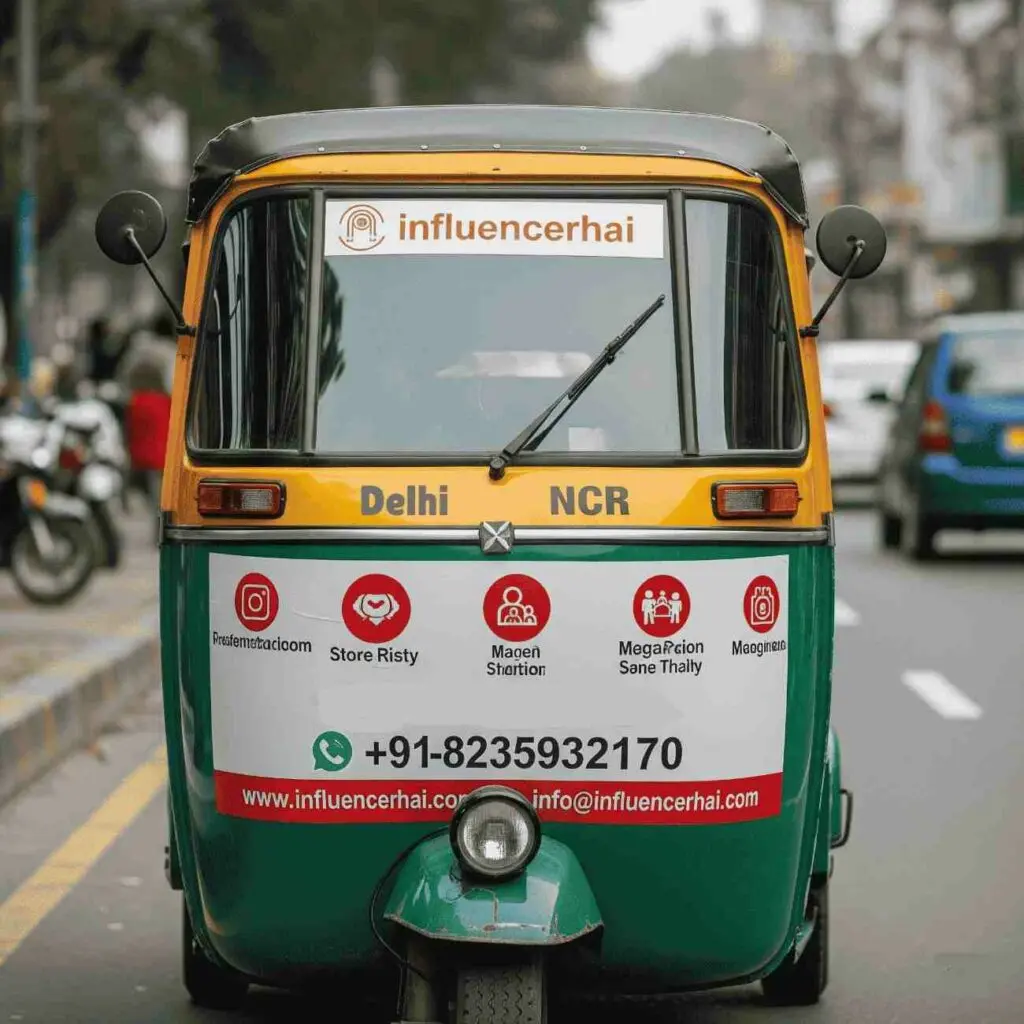
Rear panel advertising places a printed message on the back of the vehicle. It can work well for short promotional messages, brand names, telephone numbers and QR codes.
This format may suit businesses testing outdoor advertising with a relatively simple creative design.
Hood branding uses a larger advertising surface around the vehicle’s hood. It provides additional space for brand colours, product imagery and promotional messages.
The price depends on the material, dimensions, production quantity and installation arrangements. Businesses should confirm exactly which surface is included in the quotation.
Side panel advertisements are visible to pedestrians and people travelling alongside the vehicle. They can complement rear-panel branding and provide additional space for a campaign message.
The artwork should use a clear headline and limited text so that the advertisement remains readable during short viewing opportunities.
Larger branding projects cover several advertising surfaces or use more extensive vehicle wraps. These formats generally require a customised quotation because the material, installation work and covered area can vary significantly.
Ask the vendor whether the quoted amount covers only printing and fitting or also includes vehicle placement and campaign management.
Interior posters and other suitable displays can communicate information to passengers during a journey. This format may be relevant for local services, promotions and awareness campaigns.
Any interior placement must comply with applicable safety requirements and must not obstruct the driver’s visibility or passenger movement.
Auto rickshaw advertising prices vary depending on the format, quantity, duration, material, route selection and vendor’s billing model. One important distinction is whether a quotation covers a one-time branding installation or recurring advertising placement.
Published vendor rate cards show different pricing arrangements. For example, one Delhi-focused vendor lists a 24 × 6-inch rear panel at ₹170 per vehicle for orders of 500–799 vehicles and ₹140 for 800 or more. The same vendor lists hood branding at ₹650 per vehicle for 300–499 vehicles and ₹630 for fleets of 500 or more. These are advertised one-time branding prices, with GST extra, rather than universal monthly rental rates.
| Advertising format | Published price reference | Pricing basis |
| Small rear panel, 24 × 6 inches | ₹140–₹170 per auto | One-time branding; quantity-dependent |
| Larger rear panel, 24 × 18 inches | ₹240–₹270 per auto | One-time branding; quantity-dependent |
| Hood branding | ₹630–₹650 per auto | One-time branding; quantity-dependent |
| Side panels or full vehicle wrap | Custom quotation recommended | Depends on coverage and scope |
These figures are market references from specific vendor listings, not a standard price applicable to every campaign. Other vendors may quote monthly media-placement rates that include vehicle-owner payments and campaign management, while charging printing and installation separately.
Suppose a vendor quotes ₹650 per auto for hood branding, based on the published one-time rate.
| Expense | Amount |
| Branding for 300 autos | ₹1,95,000 |
| GST at 18%, if applicable | ₹35,100 |
| Total | ₹2,30,100 |
This example covers the assumed one-time branding charge only. It does not automatically include recurring vehicle-placement fees, route premiums, additional permissions or campaign monitoring.
Before finalising a budget, ask for an itemised quotation showing the branding charge, advertising duration, installation, vehicle deployment, applicable taxes and any additional fees.
Location selection should reflect the customers a business wants to reach. A campaign targeting shoppers may require different routes from one aimed at office workers, students or residents.
Businesses can evaluate commercial and residential areas such as Connaught Place, Lajpat Nagar, Karol Bagh, Rajouri Garden and Pitampura. The most suitable routes depend on the campaign objective and the availability of participating vehicles.
Commercial districts, shopping areas and residential sectors may be suitable for retail, education, healthcare and consumer campaigns. Sector 18 and Sector 62 are examples of locations that businesses can assess according to their audience.
Office districts, shopping destinations and residential neighbourhoods may be relevant for campaigns targeting working professionals, residents and local consumers.
Businesses serving these markets can evaluate residential colonies, commercial areas and neighbourhood retail routes. Route selection should be based on the actual customer catchment area rather than the city name alone.
These are potential areas for planning, not a guarantee that advertising vehicles are available on every route. Confirm the proposed deployment with the vendor before making a booking.
Auto advertising can suit businesses that need repeated visibility within a defined geographical area.
For campaigns involving political messages or other regulated advertising, confirm the relevant permissions and restrictions before production and installation.
Decide whether the campaign is intended to build brand awareness, promote a limited-time offer, announce a launch or encourage enquiries. A clear objective helps determine the format, route and budget.
Choose areas where the intended customers are likely to travel. Ask the vendor for the proposed routes, number of vehicles in each area and campaign duration.
Compare rear panels, hood branding and larger multi-panel options. The most expensive format is not necessarily the best choice; the advertisement must be appropriate for the message and viewing conditions.
Use a recognisable logo, a short headline and one clear call to action. Keep text concise, choose sufficient contrast and test QR codes before printing.
Clarify whether printing, installation, vehicle placement, route coordination and reporting are included. Ask the vendor to explain responsibility for any required permissions or additional fees.
Request installation photographs, deployment records and agreed progress reports. Document the number of vehicles and the dates on which the campaign begins and ends.
Unlike many digital campaigns, outdoor advertising does not automatically provide precise information about every person who sees an advertisement. Businesses should distinguish between estimated exposure and verified campaign delivery.
Practical measurement methods include:
A vendor’s estimated impressions should not be treated as confirmed views unless the methodology is clearly explained. Businesses should also consider other marketing activities that might have influenced customer responses.
Auto rickshaw advertising offers mobility and can support campaigns focused on particular neighbourhoods. Billboards provide a fixed presence at selected locations, while bus and metro advertising can reach different commuter audiences.
The best format depends on campaign objectives, budget, audience and location. Businesses exploring a wider local promotion strategy can also review BTL marketing campaign approaches to understand how on-ground activities and outdoor media may fit together.
For businesses combining offline promotions with digital outreach, creator content can offer a complementary way to explain a product or document a campaign. An influencer marketing agency may be relevant when a brand also wants to reach social media audiences through creator collaborations. The offline and digital activities should have clear, coordinated objectives rather than simply duplicating the same message.
Comparing unlike quotations: A one-time printing price is not equivalent to a monthly advertising-placement fee.
Choosing only by cost: Check material quality, installation, duration and the number of vehicles covered.
Using too much text: People may have only a brief opportunity to read a moving advertisement.
Ignoring route verification: Agree on the actual deployment areas and request evidence that the campaign was installed.
Assuming all charges are included: Ask about taxes, permits, union fees, route premiums and recurring costs.
Failing to track customer responses: Use campaign-specific codes or landing pages where practical.
Auto rickshaw advertising can help businesses build local visibility across Delhi NCR when the branding format, creative message and routes align with the intended audience. Understanding the difference between one-time branding charges and recurring placement costs is essential for preparing an accurate budget.
Compare vendor quotations on a like-for-like basis, confirm what is included, and establish a simple method for checking campaign delivery. InfluencerHai continues to publish educational marketing content to help businesses understand advertising formats, campaign planning and the role different channels can play in reaching customers.

Tell us your goal. Our team will build the right creator or celebrity plan for your brand.





 250+