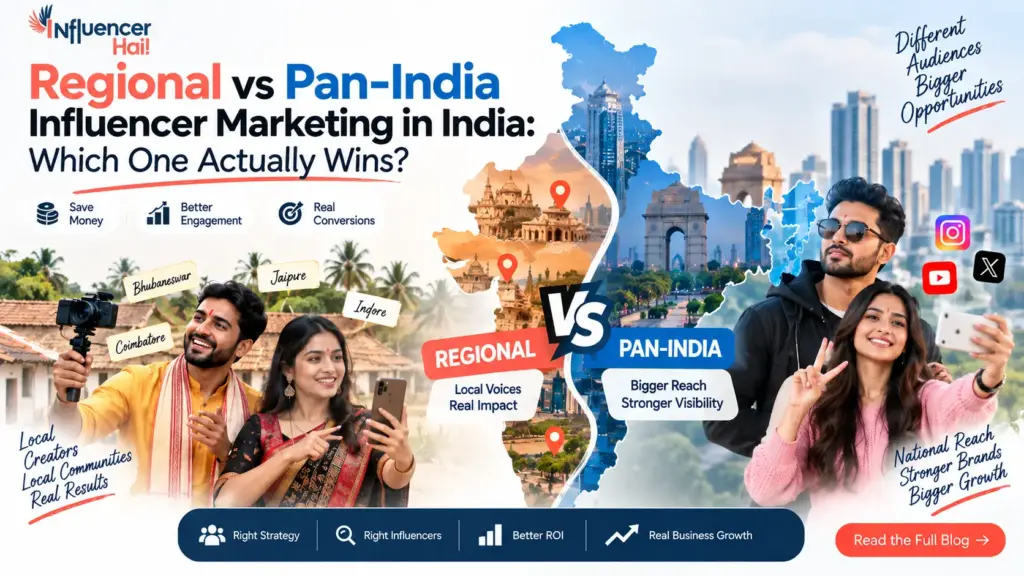
Most brands treat this as an either or decision. Go big with a celebrity and a handful of mega influencers, or go local with creators who feel like the girl next door. Pick one, run the campaign, hope for the best.
That thinking is outdated. The real answer is not regional or pan-India, it is knowing exactly when to use which, and often, using both in sequence. When planning influencer marketing in India, brands that understand this difference save money, get better engagement, and actually convert Tier 2 and Tier 3 markets that a single national campaign usually misses.
Here is a simple, honest breakdown of how the two compare, an industry by industry guide on which to pick, and a phased rollout plan that shows how to use both without wasting budget.
Regional influencers are creators rooted in one city, state, or language. Think a Jaipur fashion blogger, a Bengali food page in Kolkata, or a Sambalpuri culture creator in Odisha. Their content is usually local language first, and their strength is trust. Their audience sees them as one of their own, not as a distant celebrity.
Pan-India influencers are the mega and celebrity tier creators with reach across every metro. They usually post in Hindi or English, work with national brands, and carry aspirational appeal rather than local familiarity. Their content is built to travel across states without losing relevance.
Neither one is better on its own. They simply do different jobs, and the job should decide which one you hire.
| Factor | Regional Influencers | Pan-India Influencers |
| Follower Range | Nano to micro, roughly 1K to 100K | Macro to mega or celebrity, 500K+ |
| Cost per Post | Lower, often ₹2,000 to ₹20,000 | Higher, ₹50,000 to ₹5,00,000+ |
| Engagement Rate | Higher, typically 3 to 8 percent | Lower, typically 1 to 3 percent |
| Language | Regional language and local dialect | Hindi or English, broad appeal |
| Cultural Reference Points | Hyperlocal, festivals, dialect, local events | Broadly relatable, low local specificity |
| Best For | Store visits, Tier 2/3 markets, festivals | National launches, mass awareness |
| Campaign Speed | Faster turnaround, easier access | Slower, more approvals and negotiation |
This isn’t a small niche decision anymore, it affects most of India’s internet audience. According to the Internet in India 2024 report by IAMAI and Kantar, the country’s active internet user base reached 886 million, and 98 percent of those users consumed content in Indic languages. Even in urban India, 57 percent of internet users said they preferred content in their regional language over English or Hindi.
That means a campaign built only around Hindi or English pan-India creators is, by design, speaking a second language to more than half of urban India, and an even larger share once you move into Tier 2 and Tier 3 cities. Regional influencer marketing isn’t a nice to have anymore, it’s how most of the country actually consumes content.
The right mix depends heavily on the category. Here’s how it typically plays out.
Finance. Trust and credibility outweigh almost everything else. Pan-India finance creators with established authority help with awareness and legitimacy for products like insurance or investing apps, categories where people are naturally risk averse. But for actual sign ups in Tier 2/3 cities, regional creators explaining the same concept in the local language usually convert better, since financial decisions are rarely made off a stranger’s national level polish alone.
Fitness. Motivation and relatability drive this category more than pure reach. Pan-India fitness influencers anchor broad awareness, but regional creators tied to local gyms or community sports groups tend to convert better for supplements and fitness apps, where day to day consistency and peer-like encouragement matter more than polish.
Fashion. This category often benefits from a blend. Pan-India influencers set the aspirational direction and trend, while regional creators translate that trend into something locally wearable and locally priced. This is exactly why our Jaipur and Kolkata city guides show two very different fashion audiences responding to two very different creator styles.
Beauty. Skin tone, climate, and local beauty norms vary a lot across India, which makes regional influencers especially effective for product education and demonstration. Pan-India beauty creators still matter for launches and broad awareness, but conversion focused campaigns in smaller cities usually lean regional.
Food and Restaurants. Almost entirely a regional game. A food page rooted in a specific city, speaking to that city’s specific taste and price sensitivity, will always beat a generic national food influencer for driving actual footfall or orders.
Real Estate. Hyperlocal by nature. Buyers trust creators who know the actual neighbourhood, the actual commute, and the actual price range, which is why our Rajarhat and New Town real estate campaigns worked best with location specific creators rather than a national name.
As a general rule, lean pan-India when the goal is awareness or category credibility, and lean regional when the goal is trust, education, or direct conversion in a specific market.
Most brands that succeed in Tier 2 and Tier 3 markets don’t pick a side, they sequence both, in this order.
Phase 1: National Seeding. Run a short pan-India campaign first to establish that the brand is real and worth paying attention to. This builds baseline credibility before any local activation begins.
Phase 2: Regional Activation. Once awareness exists, bring in regional creators city by city, using local language content to drive deeper engagement, product education, and first conversions.
Phase 3: Sustained Local Presence. Keep a smaller, ongoing group of regional creators for community engagement and repeat promotions, while pan-India influencers are reserved for periodic national moments like festive sales or major launches.
This sequencing means you’re not paying pan-India rates for every city level push, and you’re not asking regional creators to do the job of building national credibility, which usually isn’t a fair ask for their scale.
The most common mistake is running one campaign, built for one city, and copy pasting it across the whole country. A Delhi style campaign dropped into Kolkata or Bhubaneswar without any local adjustment usually falls flat, because the audience can tell it wasn’t made for them.
The second mistake goes the other way. Some brands go all in on cheap regional creators and never scale up, which caps how far the brand can grow beyond a handful of cities.
The fix isn’t complicated, it’s just about matching the tool to the job and the phase, instead of using the same approach for every city and every stage.
We work from a single network of over 500,000 creators across India, filtered by both national reach and hyperlocal presence, so a single campaign brief can pull in Tier 1 mega influencers and Tier 3 regional voices together, instead of running two separate campaigns through two separate processes.
Our process stays the same either way. We start by defining the campaign goal, then filter our creator network by niche, location, audience, and engagement. Every shortlisted creator goes through an authenticity check before briefing and content creation begins. Once content is live, we track performance and adjust based on what’s actually working in each region, not just nationally.
Most agencies pick a lane. Some specialise in celebrity and mega influencer bookings for big national brands. Others are small, city based outreach shops with no ability to scale beyond one region.
InfluencerHai sits in neither camp. Our body of work includes deep, dedicated city and state guides for Jaipur, Kolkata, Bhubaneswar, Puducherry, Visakhapatnam, and Jharkhand, proof that we understand regional markets at a granular level, not just as a line item. At the same time, our campaign history with Amazon, HDFC, Meesho, Zerodha, Groww, CRED, Oppo, and Tata shows we can execute at true pan-India scale.
That combination, real regional depth plus real national reach, is what most agencies simply cannot offer at the same time.