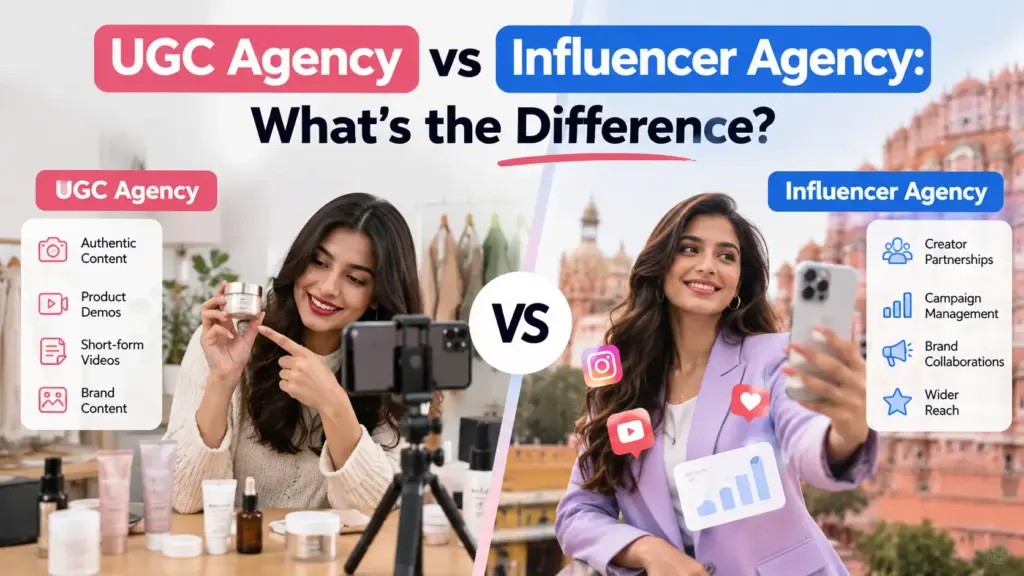
If you’re a brand exploring creator content for the first time, you’ve probably run into both terms, UGC agency and influencer agency, and noticed they’re sometimes used almost interchangeably. They’re not the same thing, and picking the wrong one for your goal is one of the more common ways brands waste a content budget before they even run a single campaign.
This guide breaks down the real difference, when you need one, the other, or both, and how to decide without guessing.
A UGC (user-generated content) agency sources creators to produce content specifically for the brand’s own use, product demos, testimonials, reviews, and social-ready videos, usually meant for the brand’s own ads, website, or social channels rather than the creator’s own page.
The creator’s follower count barely matters here. What matters is whether they can produce content that looks and feels authentic, the kind of video a real customer might film on their phone, rather than a polished studio ad. A UGC creator with 2,000 followers can be just as valuable as one with 200,000, sometimes more, since smaller creators often produce content with a more natural, unscripted feel that performs better in paid ads precisely because it doesn’t look like an ad.
This is also why UGC work tends to be priced per piece of content rather than per audience reached. You’re not paying for distribution, you’re paying for a usable asset.
An influencer marketing agency works differently. Here, the creator’s own audience is the point. The brand pays (or barters) for a creator to post content to their own followers, and the value comes from that creator’s reach, trust, and influence over their specific audience.
Follower count and engagement rate matter a lot more here, since the whole model depends on the creator’s existing community actually seeing and responding to the content. A campaign built around 10 well-matched micro-influencers can outperform one built around a single large creator, but the logic is still fundamentally about reach and audience fit, not about producing a reusable video asset.
| Factor | UGC Agency | Influencer Agency |
| Where content gets posted | Brand’s own channels, ads, website | Creator’s own social profile |
| What matters most | Content quality and authenticity | Audience size and engagement |
| Follower count | Mostly irrelevant | Central to the decision |
| Typical use case | Ad creative, product demos, testimonials | Brand awareness, audience reach |
| Content usage rights | Usually full rights for brand reuse | Often limited to the original post |
| Pricing logic | Per piece of content | Often tied to reach or follower tier |
| Measured by | Ad performance, conversion rate | Reach, engagement, impressions |
Cost is one of the clearest ways to tell the two apart, not just in the numbers, but in what you’re actually paying for.
UGC pricing is usually per piece of content, you’re paying a creator to produce a specific asset: one demo video, one testimonial, one unboxing clip. Follower count barely factors in. What drives the price is production effort, how much filming, editing, and revision the piece needs, and whether extended usage rights (for paid ads, long-term website use, etc.) are included. For a full breakdown of what this typically costs in India, see our UGC content pricing guide.
Influencer pricing works differently. It’s typically tied to reach and audience size, a creator’s rate usually scales with their follower count and engagement rate, since you’re paying for access to their audience, not just a piece of content. Two creators making near-identical videos can charge very different rates if one has ten times the following. Our influencer marketing cost guide covers rates by creator tier in detail.
This is also why UGC campaigns are often more budget-predictable for brands just starting out, you know roughly what a piece of content costs regardless of which creator makes it, whereas influencer pricing can swing significantly based on who you work with.
A dedicated UGC agency handles sourcing creators specifically for this, managing briefs, approvals, and content rights so the final assets are actually usable in your ads, not just nice to look at once and forget.
This is where a full-service influencer marketing agency fits, managing creator discovery, negotiation, and campaign coordination around reaching real audiences, not just producing footage for you to repurpose later.
Yes, and many brands do, often without realizing they’re running two distinct strategies at once. A common approach: run an influencer campaign for reach and awareness, then take the strongest-performing creator content, with proper usage rights secured upfront, and repurpose it as paid ad creative. This essentially gets you UGC-style assets out of an influencer campaign without running two separate processes or paying for both from scratch.
The reverse also works: a brand might run a dedicated UGC campaign purely for ad creative, with no intention of the content ever being posted on the creator’s own page at all. In that case, the creator is essentially acting as a video production partner rather than a distribution channel, and the deal should be structured, and priced, accordingly.
A third, increasingly common pattern: brands brief a UGC creator and an influencer creator on the same product at the same time, one for the ad library, one for organic reach, so both goals are being served in parallel rather than sequentially.
Hiring an influencer for UGC work. A creator with 500,000 followers isn’t automatically good at making authentic-feeling demo content, those are genuinely different skills, closer to acting and production than to audience-building. You may end up paying influencer-tier rates for UGC-tier output, and getting content that still looks too polished to work as ad creative.
Skipping content usage rights in a UGC deal. If the whole point is reusing the content in ads, this needs to be agreed and paid for upfront, not assumed after the fact. A creator who agreed to a single organic post is well within their rights to push back if you later want to run their face in a paid ad campaign for six months.
Judging UGC creators by follower count. It’s simply the wrong metric here. Content quality and authenticity matter far more than audience size for this format, and filtering UGC creators the same way you’d filter influencers often means overlooking the people best suited for the job.
Running an awareness campaign through a UGC-only approach. If the goal is reach, content made purely for your own channels won’t get you there on its own, you need creators posting to their own audience to actually extend your reach beyond your existing followers.
Treating the two budgets as interchangeable. A brand that moves money freely between “UGC spend” and “influencer spend” without tracking which goal each dollar is actually serving usually ends up unable to tell which approach is working.
Ask yourself one question first: do I need people to see this on the creator’s page, or do I just need good content for my own channels?
A UGC agency and an influencer agency solve genuinely different problems. One gets you content for your own channels; the other gets you access to someone else’s audience. Knowing which one your campaign actually needs, before you start reaching out to creators, saves budget and avoids mismatched expectations on both sides of the deal.
Not sure which approach fits your brand? Get in touch with our team and we’ll help you figure out the right mix.