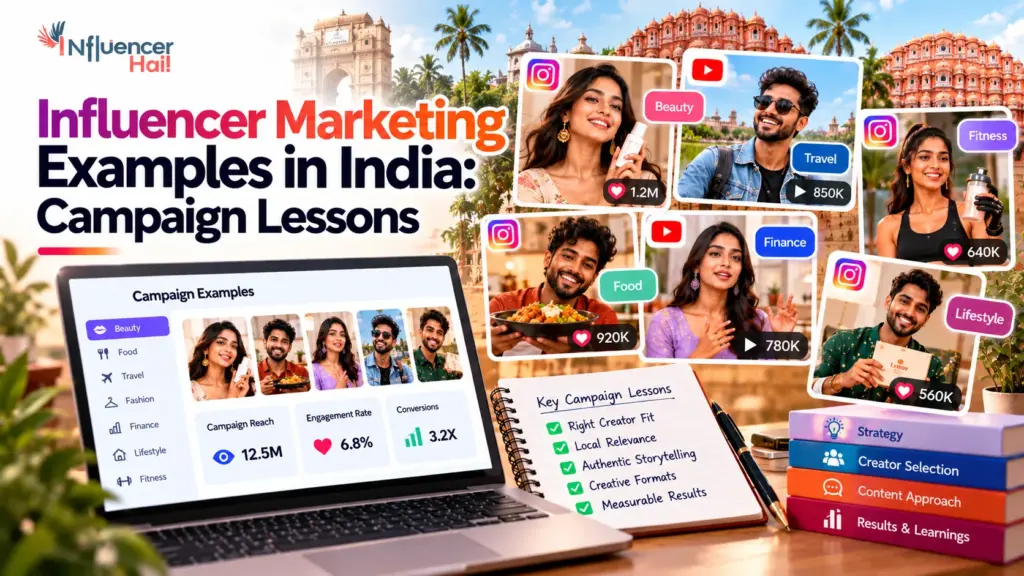
Good influencer marketing examples show you what works before you spend your own budget. At InfluencerHai, we plan creator campaigns for brands, and many teams ask us for real examples first. This guide shares recent examples from India, explains what each brand did, and shows what you can copy.
As an influencer marketing agency in India, we also know that big numbers do not tell the whole story. So for each example, we share what the source reports and the simple lesson behind it.
A good example has four things: a clear goal, the right creator, a simple way to track results, and honest reporting. Many online lists show big numbers with no proof. In this post, we only share what the source reports. If a number is missing, we say so and focus on the lesson. Before you start your own campaign, learn how to measure influencer campaign performance.
KFC India x CarryMinati. CarryMinati is a YouTuber with about 67 million followers. He did not just post an ad. He helped create the KFC Menu Saucy Popcorn. Exchange4media reports that the campaign alone got 36.7k comments on KFC India’s Instagram page.
Lesson: when a creator helps build the idea, the content feels real, not scripted.
IKEA in Delhi-NCR. When IKEA launched its e-commerce service in Delhi-NCR, it took creators’ social posts and turned them into hoardings at malls like Select Citywalk and DLF CyberHub.
Lesson: good creator content can work offline too, as long as you have the rights to use it.
Planning a launch like this takes many steps, and our influencer marketing services cover creator selection, briefs and tracking.
Swiggy and Britannia, ‘Croissant to Prashant’. In 2025, a 16-year-old creator named Ayush Chaurasiya said ‘croissant’ as ‘Prashant’ in an Instagram filter video, and it went viral. Swiggy sent searches for ‘Prashant’ to croissants in its app. Britannia changed its Instagram bio. Brands like IKEA and Lakme joined in too.
Lesson: speed matters. The brands that moved in days got the attention.
Plum and Kulu. Creator Aditya Kulshrestha, known as Kulu, stumbled over the word ‘niacinamide’ on a podcast. Plum turned it into a skincare hamper, a pronunciation guide and a podcast series called Skin City, with Kulu as the first guest.
Lesson: a funny moment can become a full campaign when the brand plays along.
You cannot plan viral moments, but you can plan your creator list. Our guide on how to hire influencers shows how to build one.
NESCAFÉ and Minecraft creators. NESCAFÉ launched its Cold Coffee with 27 Minecraft livestreams, timed around a big movie release. According to exchange4media, the launch stream by GamerFleet alone got 1.2 million views and 6.6 million impressions over one weekend. Streamers paused their games to drink the coffee.
Lesson: go where your audience already spends time, and let the product fit into the content. These are strong influencer advertising examples because the product is part of the show, not a separate ad.
Duolingo’s Telugu launch. When Duolingo added a Telugu-to-English course, its agency Digitas India built a campaign called ‘Go from a star to a global star’, inspired by Tollywood. Local creators joined the launch and made a Telugu rap song about turning a local star into a global one.
Lesson: language alone is not enough. Local film culture, music and humor made the message feel at home. These are the kind of influencer marketing examples in India that show why regional creators matter. If you plan content in many languages, read our guide on multilingual influencer campaigns.
Diwali is the busiest season for creator campaigns. Here are three examples from Diwali 2025, as reported by Social Samosa:
According to the Qoruz Festive Season Report 2025, reported by exchange4media, influencer spending was projected to cross ₹700 crore in the 2025 festive cycle.
Lesson: plan early, and pick creators who fit the festival and the city. These examples of influencer marketing show that a pan-India message does not work for every market. For the full picture, see our guide to influencer marketing in India.
Meesho’s Diwali work with creators from Tier 2 cities is a good micro and local example. It shows that smaller creators can speak to a city in a way big names cannot.
The trend is growing. A preview of the Kofluence 2025 report says 52% of influencer spend goes to micro-influencers. This is a vendor report, so treat it as a guide, not a rule.
Lesson: micro creators work well when you want local trust and tighter budgets. Check the audience location and the comments before you sign anyone.
IKEA’s hoardings and Plum’s hamper show another idea: creator content can live beyond the original post. Brands use it on product pages, in ads, in stores and on outdoor media. This is where UGC content is useful, because it feels natural and is easy to adapt for many placements.
If you want to run creator videos as ads, read our step-by-step guide to turn influencer content into paid ads. Always get the right permission first.
Here are eight campaigns we have run. The numbers come from our own campaign reports. Each campaign had a different goal, so we show what it aimed to do and what it delivered.
The goal was to bring people into stores and create buzz. The campaign reached 2.9M people, earned 180K engagement and used 85 creator collaborations. It drove real foot traffic and talk around the stores.
The goal was to build trust for India’s shift to electric cars. Creators shared test-drive content, and the campaign reached 3.6M people with 210K engagement across 110 collaborations.
The goal was strong reach on launch day. We worked with camera-first creators, and the campaign passed 1.2M reach on the first day. In total, it reached 4.8M people, earned 260K engagement and used 80 collaborations.
The goal was app downloads. One regional campaign brought more than 67K app downloads, along with 3.4M reach, 210K engagement and 180 collaborations.
Creators told stories around the product instead of reading ads. The campaign delivered a 3.2x lift in engagement, with 2.1M reach, 95K engagement and 64 collaborations.
We used niche creators to launch the brand to the right listeners. The launch post earned more than 12.5K likes, and the campaign reached 1.8M people with 72K engagement across 95 collaborations.
For both brands, creators explained investing in simple words. Zerodha’s campaign focused on investor education and reached 4.1M people, with 260K engagement and 95 collaborations. Groww’s campaign reached 3.4M people, with 205K engagement and 102 collaborations.
Our influencer campaign management process is similar each time. We set the goal, choose creators, write a simple brief, approve the content and track results. We share results only when we can back them up with real data.
When you look at all the examples together, five patterns appear:
You can use the same ideas for any brand. Start with campaign planning in five simple steps:
Budget matters too. Our guide to influencer marketing cost in India explains what affects creator fees.
Also decide how long and where you can use the content. Read about influencer usage rights before you sign any agreement.
InfluencerHai is an influencer marketing agency in India with offices in Jaipur and Noida. We help brands plan, run and measure creator campaigns, from the first idea to the final report.
Here is how InfluencerHai can help your brand:
Every brand is different, so we start with your goal and budget before we suggest a plan. We will also tell you honestly what is realistic.
The best influencer marketing examples share the same simple ideas: a clear goal, the right creator, local relevance and honest tracking. Use the examples above as a starting point, and test your own ideas on a small scale first. If you want help planning your next campaign, InfluencerHai can support you, so get in touch with our team today.