Every influencer deal follows the same path: you prove your numbers, pitch, agree a price and get paid. Many creators and brands do it with guesses, screenshots and a document that looks different every time. A good influencer collaboration toolkit replaces the guesswork with a few simple, repeatable steps.
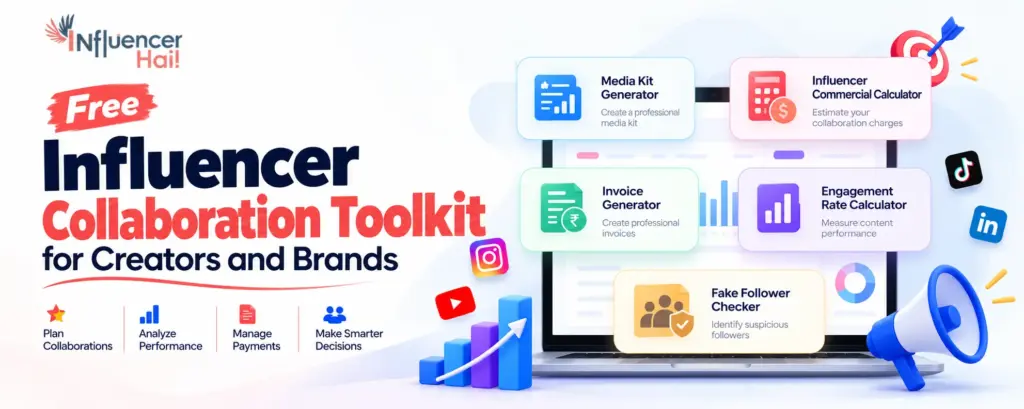
In this guide, we walk through five free influencer tools in the order of a real brand deal: engagement rate, audience quality, media kit, pricing and invoicing. Each one works without sign-up, and each is built for how deals work in India.
An influencer collaboration toolkit is a set of tools that helps creators and brands handle each stage of a partnership. Think of it as a checklist you can click through:
Creators use these tools to look professional and ask for fair fees. Brands use them to compare creators on the same terms and to plan a realistic budget. Agencies use them to keep documents and numbers consistent across many creators.
The five tools below are all free. You can find the full set on our free influencer tools page.
Brands usually look at engagement before anything else. Engagement rate shows how many people interact with your content compared with how many see it or follow you.
The most important point is the formula. A rate worked out from followers, from reach or from views gives three different results for the same post, so always compare like with like. Use the same set of recent posts each time, and note which formula you used.
Our engagement rate calculator labels the formula it uses and lets you compare recent posts, so you can see your average and your typical result and put them next to sourced benchmarks.
A large follower count means little if the audience is not real. Brands know this, so they look at audience quality too. Warning signs include a sudden jump in followers, very few comments compared with likes, and generic or repeated comments.
The Instagram fake follower checker looks at an account’s profile signals against creators of the same size and gives an estimate from a follower sample, with a margin of error. Treat the result as a signal, not proof. No tool can say for certain which followers are fake, so use it alongside your own review of the comments and the audience location.
For creators, running the check before a pitch lets you spot a problem and explain it. For brands, it is a quick screen before you shortlist.
Brands shortlist creators in minutes. A clear media kit answers three questions fast: who you are, who watches you and what you have done before.
A good media kit includes:
The free influencer media kit generator turns your platforms, audience and past work into a brand-ready PDF with a live preview and a choice of templates.
Before you answer a brief, check what the deliverables, usage rights and exclusivity are reasonably worth. Many calculators multiply followers by a fixed rupee figure. Followers do not watch every post, so a better starting point is expected views, with followers as a second check.
Our influencer pricing calculator works in rupees and prices three things separately: the content fee, the usage rights and exclusivity. It also adds GST and shows TDS, so the final numbers match what the brand’s finance team will see.
Here is a worked example from the calculator, so treat the numbers as an illustration: a creator with 50K followers in beauty and skincare, about 18K average Reel views and 6% engagement. For one Instagram Reel, three Story frames and 30 days of paid ad usage, the calculator suggests about Rs 39,500, with a range of about Rs 31,500 to Rs 49,500. Without paid ads, the quote drops to about Rs 33,000.
The result is an estimate based on published ranges and stated assumptions, not a market rate. Use the range as a starting point for talks, and always agree the length of paid usage in writing. Our guide to influencer usage rights in India explains what to cover.
Finance teams pay against a proper invoice. A missing number, a wrong tax line or a vague description can hold up a payment for weeks.
The invoice generator for influencers creates a PDF invoice with GST and TDS lines worked out for you, and offers several invoice designs. It saves a copy of each invoice you download so you can find it later.
Here is the tax background in simple words. GST is charged on the fee by creators who are registered for it. TDS is an amount the brand holds back from the payout and deposits with the government, and it does not add to the brand’s cost. This is general information, not tax advice, and the rules and limits can change, so check them with a chartered accountant.
Brands can use the same toolkit from the other side of the deal. Compare creators with the engagement rate calculator and the fake follower checker, then use the pricing calculator in brand mode to plan a budget. It adds up per-creator fees, extra costs, an agency fee and GST, so you can see a realistic total before you start outreach.
Not every tool is equally useful, so check a few things before you rely on one:
Tools help you prepare, but they do not run a campaign. When a brand works with many creators at once, the work grows quickly: briefs, approvals, usage rights, tracking and payments. This is where an influencer marketing agency can save time and reduce mistakes.
As an influencer marketing agency in India, we help brands find creators, manage the campaign and report results. Our influencer marketing services cover that work, and our UGC content team can produce creator-style videos for ads. Whoever you choose, ask an influencer marketing agency to show its process and real examples before you sign.
A good influencer collaboration toolkit turns each deal into a simple path: measure, vet, pitch, price and bill. The tools above are free and need no sign-up, so you can try them on your next brief. If you want help planning a campaign from the first shortlist to the final report, InfluencerHai can support you, so get in touch with our team to get started.

Tell us your goal. Our team will build the right creator or celebrity plan for your brand.





 250+