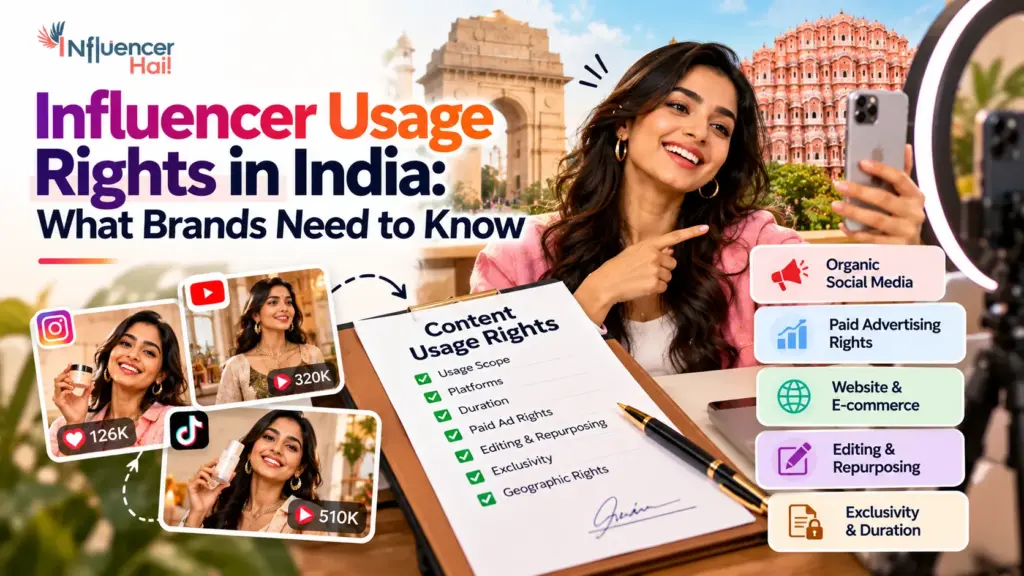
Influencer Usage Rights in India: What Brands Need to Know

Author: Gourav Kumar October 9, 2026

A brand pays a creator to publish a sponsored video. It performs well, so the marketing team wants to run it as an ad, put it on product pages and use it in an email campaign. Then someone asks: are we actually allowed to do that? Influencer usage rights in India decide the answer, and too many brands only ask the question after the content is live.

As an agency, we’ve seen usage terms treated as an afterthought, and it usually costs brands time or money later. This guide explains what usage rights are, who owns influencer content, which rights to ask for, and how to put them in writing before production starts. It is a business guide, not legal advice, so have a lawyer review your contracts.

What Are Influencer Usage Rights, and Who Owns the Content?

Influencer usage rights are the permissions a brand has to use creator content. They cover what content you can use, where it can appear, how long you can use it, and whether you can edit or repurpose it.

The most important distinction is between ownership and permission:

  • Ownership is about who holds the copyright in the content.
  • Permission is about what the brand is allowed to do with it, usually through a content license.

In India, copyright in a creator’s work generally starts with the creator, and moving it to someone else usually needs a written assignment. Moral rights, such as credit and protection against distortion, can also stay with the creator after an assignment. The details depend on the facts and the agreement, so do not assume every creator owns every element of a collaboration, or that a brand owns everything it paid for.

Payment alone is not unlimited permission. Paying a fee for one Instagram post does not automatically give you the right to run that video as a paid ad for two years. Brand-provided materials, third-party music and stock footage add another layer, because the creator may not be able to grant rights over them at all.

Types of Influencer Usage Rights Brands Should Understand

  • Organic social media usage: reposting creator content on the brand’s own channels.
  • Paid advertising rights: using creator content in paid social campaigns or other digital ads.
  • Website and e-commerce usage: showing creator content on product pages, landing pages or the brand site.
  • Editing and repurposing rights: cropping, subtitling, adding branding, shortening videos or adapting content for different placements.
  • Exclusivity rights: stopping the creator from working with competing brands for an agreed scope and period.
  • Raw footage rights: access to unedited files, which is often priced separately from the final video.
  • Time-limited vs perpetual use: a defined usage term is easier to price and manage than a perpetual license, and wording matters a great deal when a contract says unlimited or forever.

Usage Rights for Paid Ads and Whitelisting

Permission to publish an influencer post organically does not necessarily cover paid advertising. Paid use needs its own permission, because the content may reach audiences far larger than the creator’s own following.

Two setups come up most often. In the first, the brand runs the creator’s content from its own ad account. In the second, often called whitelisting, the brand runs ads through the creator’s handle with the creator’s authorization, where the platform supports it. Features and names change, so check the platform’s current terms.

Before you agree to either, define:

  • Ad duration, platforms and geography
  • Editing limits
  • Permission to use the creator’s name, image and handle
  • How access is granted, and how it can be withdrawn

If you want a step-by-step process, read our guide on how to turn influencer content into paid ads.

What Should an Influencer Usage Rights Agreement Include?

This checklist covers the terms most brands should settle in writing:

  • Exact content covered by the agreement
  • Permitted platforms and channels
  • Organic usage versus paid advertising
  • Usage period and start date
  • Geographic scope
  • Editing, adaptation and repurposing permissions
  • Creator name, likeness and handle usage
  • Exclusivity and competing-brand restrictions
  • Compensation and any additional license fees
  • Third-party music, footage and other asset permissions
  • Renewal, termination and what happens after expiry
  • Approval process and each party’s responsibilities

Treat this as a business checklist, not a substitute for legal review.

How Much Do Influencer Usage Rights Cost in India?

There is no universal usage-rights fee, and anyone quoting a fixed percentage without evidence is guessing. What you can say is that the fee should change when the scope changes. A creator granting a few months of organic use is not doing the same deal as one granting long-term paid use across several platforms.

These factors usually affect pricing:

  • Duration of use
  • Paid versus organic usage
  • Platforms and placement types
  • Creator reach and demand
  • Exclusivity requirements
  • How much editing or repurposing you need
  • The scope of the overall campaign

For wider budgeting, see our breakdown of influencer marketing cost in India.

Common Influencer Usage Rights Mistakes and How to Avoid Them

  1. Assuming payment covers every right. Spell out each use in the agreement.
  2. Reposting content without checking the contract. Keep a list of approved uses for every asset.
  3. Running creator videos as paid ads without permission. Get paid-use rights written down first.
  4. Ignoring music and third-party licenses. Confirm clearances for every planned use.
  5. Skipping an expiry date. Record a start date and an end date for each asset.
  6. Asking for unlimited exclusivity. Define the category, scope and period.
  7. Editing beyond the agreed permissions. Get approval for changes that alter the message.
  8. Using content after rights expire. Set reminders and plan renewals or removal.

How to secure influencer usage rights before a campaign

  1. Define the intended use. Decide whether the content is for organic posts, paid ads, e-commerce or several channels.
  2. Document the permissions. Put platforms, duration, territory and editing rights in writing.
  3. Check third-party assets. Confirm that music, footage and images can be used for the planned purpose.
  4. Track expiry. Record license dates, renewals and where each asset is published.

This is also where good campaign planning pays off, and our influencer marketing services are built around briefing, creator coordination and documented deliverables.

If you are still building your creator shortlist, our guide on how to hire influencers covers outreach and negotiation.

Influencer Usage Rights vs UGC Usage Rights

The two overlap, and neither is a separate legal category. The practical difference is what the creator actually does in the project.

Consideration Influencer collaboration UGC collaboration
Typical creator role Publishes content and may provide audience access Produces content, sometimes without publishing it
Audience access Often part of the deal Not necessarily included
Paid ad permissions Must be agreed Must be agreed
Content ownership Depends on law and contract Depends on law and contract
Main consideration Publishing plus reuse permissions Production plus reuse permissions

If your plan is mostly ad creative and product-page content, look at creator-led UGC content, where reuse rights are usually the main point of the deal.

To decide which model fits, read our comparison of UGC vs influencer marketing.

Example: Influencer Usage Rights in Practice 

This is an illustration, not a client case. A skincare brand commissions a creator to make a product video for Instagram. Later, it wants to use that video in paid ads and on its e-commerce product page. Before doing either, the brand should confirm:

  • Does the agreement cover paid advertising?
  • Is website and product-page usage included?
  • Can the brand shorten the video or add captions?
  • Are the music and other assets cleared for these uses?
  • When do the permissions expire?

The point is to agree on each intended use in advance. One contract structure does not fit every campaign.

How an Agency Helps Brands Manage Usage Rights

Good usage-rights management is mostly organization: clear briefs, one record of what each creator agreed to, and a calendar for expiries. As an agency, we handle campaign planning, creator coordination, deliverable tracking and documented permissions so that nothing gets lost between teams.

Brands comparing the best influencer marketing agency in India often ask how usage terms are handled, so make sure any partner can show you its process in writing.

Conclusion

Influencer usage rights in India are easiest to manage when you decide where, how and for how long content will be used before production starts. Put the permissions in writing, keep paid-ad rights separate from organic rights, check third-party assets and track expiry dates. If you want help setting this up, InfluencerHai can plan it with you, so get in touch with our team before your next campaign.

Frequently Asked Questions

They are the permissions a brand has to use creator content: where it can appear, for how long, in what formats and whether it can be edited. They are usually set in the influencer agreement.

Not automatically. Copyright generally starts with the creator, and transferring it usually needs a written assignment. Many deals only grant a license to use the content. Check your contract and take legal advice.

Only if the agreement allows it. Permission to post organically does not necessarily cover paid ads, so agree on platforms, duration, geography and editing limits in writing.

For as long as the agreement says. Use a defined term with a start and end date, and be careful with wording like perpetual or unlimited, since scope affects both fees and risk.

If the agreement does not clearly cover reposting on the brand's own channels, yes. Ask for organic repost rights in the contract so there is no doubt later.

Usually the brand, either inside the main fee or as an extra license fee. Wider usage, such as paid ads or longer terms, typically costs more than basic organic use.

Only within the permissions in the agreement. Cropping, captions and shortening are often agreed upfront, but changes that alter the message should need the creator's approval.

The brand should stop using the content, or renew the rights with the creator. Plan the post-expiry handling, such as removing ads and taking content down, in the original agreement.

It means a brand runs ads through a creator's handle with the creator's authorization, where the platform supports it. It needs its own permission, duration and access terms

It is risky. Because transfers of copyright generally need to be in writing, and disputes are hard to settle without records, put usage rights in a written agreement or at least in a signed email brief.

Get In Touch

    Register as a Influencer