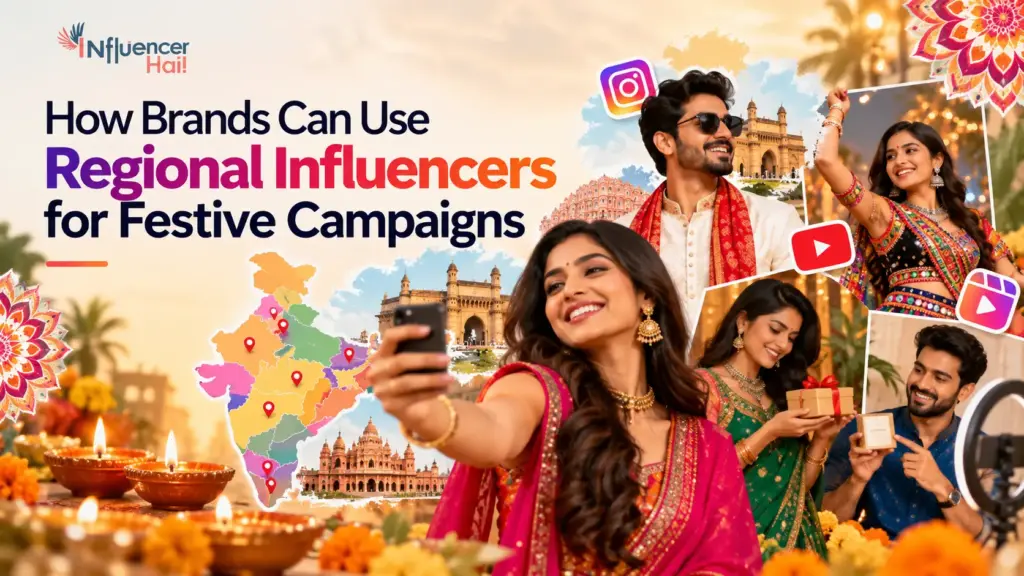
India’s festive season doesn’t look the same everywhere. Navratri means something different in Gujarat than it does in West Bengal, where the same weeks center on Durga Puja instead. Dussehra celebrations in North India differ from how the South marks the same period. A single national creator campaign, run the same way for every city, misses most of that nuance.
This is where regional influencers for festive campaigns make a real difference. A good influencer marketing agency adapts creator selection, language, and content to a region’s specific culture and buying behavior, rather than running one generic campaign nationwide. This guide covers why that matters, how to choose the right regional creators, and how to build and measure a festive campaign that actually reflects where your audience lives.
Festive buying behavior is deeply tied to local culture, not just the calendar date. A creator who understands a region’s specific traditions, language, and shopping habits can make a brand’s festive message feel like part of the celebration, rather than an outside advertisement dropped into it.
Regional influencer marketing in India works because of a few compounding factors:
Cultural relevance. A Diwali post that references regional rituals, specific sweets, or local shopping streets resonates more than generic “festival of lights” messaging.
Regional trust. Local creators are often seen as part of the community, not outsiders, which matters more during festivals, a time built around family and tradition.
Local language. Content in a region’s own language, or a natural mix of that language and English, tends to feel more personal than a translated national script.
Audience familiarity. Regional creators already understand their audience’s specific concerns, price sensitivity, preferred shopping channels, gifting customs, without a brand needing to explain it to them.
Better targeting. Instead of reaching a broad national audience with a diluted message, regional creators let brands speak precisely to the people most likely to respond during that specific festival window.
Both approaches have a place, but they solve different problems.
| Factor | Regional Influencer Marketing | National Influencer Marketing |
| Audience | Specific city, state, or language group | Broad, pan-India |
| Reach | Smaller, more concentrated | Larger, more diffuse |
| Language | Native or regional language | Usually Hindi or English |
| Cultural relevance | High, tied to local customs | General, broadly applicable |
| Engagement | Often higher within the target audience | Can be lower per-person despite higher total reach |
| Cost | Generally more cost-efficient per engaged viewer | Higher cost per creator, especially at scale |
| Best campaign objective | Deep connection, local sales, cultural relevance | Broad awareness, brand visibility |
Neither replaces the other. A brand with a genuinely national product may still need broad reach, but layering regional creators into that strategy, especially during festivals, usually strengthens the campaign rather than competing with it.
Language is more than translation, it’s part of how trust is built during a festival.
Hindi influencer marketing works well across much of North and Central India, but even within Hindi-speaking regions, tone and references shift from state to state.
Tamil influencer marketing connects with audiences in Tamil Nadu in ways a Hindi or English post simply can’t replicate, especially for festival content tied to regional customs and local shopping behavior.
Bengali influencer marketing matters enormously during Durga Puja specifically, a festival that carries deep regional identity in West Bengal, distinct from how the rest of India marks the same period.
Multilingual influencer marketing, creators who move naturally between a regional language and Hindi or English, often perform especially well in tier 2 cities, where audiences expect that blend in everyday content.
The underlying point: language should be chosen based on where the audience actually lives and how they naturally communicate, not based on what’s easiest for the brand to produce once and reuse everywhere.
Selecting regional creators takes more than searching by city name. A few criteria matter more than people expect:
Follower count alone should not determine regional creator selection. A creator with a smaller, highly engaged local audience frequently outperforms a larger account with a generic, scattered following.
A practical framework helps keep this from becoming guesswork:
Region → Audience → Creator → Festival → Content → Offer → Tracking
Region: Decide which specific regions matter most for this campaign, not every festival needs every state covered.
Audience: Define who within that region you’re actually trying to reach, demographics, interests, buying behavior.
Creator: Shortlist creators who genuinely fit that audience, using the criteria above rather than a generic influencer list.
Festival: Confirm which specific festival, and which days within it, the campaign should align with, timing matters as much as the message itself.
Content: Brief the creator on format and tone, while leaving room for them to adapt it naturally to their own audience.
Offer: Decide what the audience actually gets, a discount, a gift, early access, tied specifically to the festival rather than a generic promotion with festive branding slapped on top.
Tracking: Set up measurement before the campaign goes live, not after, so results can actually be attributed back to each region and creator.
Diwali is the single biggest festive moment for most Indian brands, and it supports a wide range of campaign formats:
The strongest Diwali campaigns usually combine two or three of these formats rather than relying on just one.
These festivals often overlap in timing but carry very different regional meaning, and campaigns should reflect that rather than treating them as one generic “festive season” moment.
Navratri: Particularly significant in Gujarat and parts of Western India, with strong ties to fashion, dance, and community events. Regional creators covering dandiya and garba culture can bring genuine relevance that a national campaign can’t.
Durga Puja: Central to Bengali cultural identity, especially in West Bengal. Creators with real connection to the festival’s pandals, rituals, and community celebrations tend to produce far more authentic content than outside creators attempting to cover it generically.
Dussehra: Celebrated across much of North India with strong regional variation in how it’s marked. Local creators can speak to these specific regional customs in a way a single national script rarely captures accurately.
Rather than running one identical campaign across all three festivals, it’s worth treating each as its own regional moment, with creators chosen specifically for that festival’s cultural context.
Tier 2 cities offer a genuinely underused opportunity during festive campaigns, for a few concrete reasons:
Local trust tends to run deeper in tier 2 cities, where creators are often seen as recognizable community figures rather than distant online personalities.
Regional reach in these cities often comes at a lower cost than equivalent reach in metro markets, without necessarily sacrificing engagement quality.
Niche communities within tier 2 cities can be reached precisely through creators already embedded in those specific interest groups.
Cost efficiency makes tier 2 city creators especially attractive for brands wanting broader regional coverage without a metro-sized budget.
Local-language content is often more natural and less performative in tier 2 markets, where audiences expect and prefer it.
City-level campaigns in these markets can be tested and scaled more easily, since the audience is more concentrated and easier to measure precisely.
For festive campaigns specifically, tier 2 cities often respond especially well, festivals tend to carry stronger community and family significance outside major metros.
User-generated content adds another layer to a regional festive strategy, particularly useful for brands wanting authentic-feeling assets they can reuse across their own channels.
Strong formats for this period include product demonstrations tied to festive use cases, testimonials from real customers preparing for the festival, content showing festive routines or rituals, unboxing videos for gifted products, gift recommendation content, and regional-language UGC built for specific local audiences. This kind of content also works well for paid amplification once the organic festive window has passed.
For a deeper breakdown of how UGC differs from standard influencer content, and when each approach fits better, see our guide on UGC and influencer marketing.
Measuring a regional festive campaign well means going beyond likes and surface-level engagement.
Track reach, engagement, and video views at both the creator level and the regional level, since a campaign can perform well overall while actually underperforming in one specific region. Clicks, promo codes, and affiliate links help attribute real traffic and sales back to individual creators. Conversions and cost per acquisition show which regions and creators delivered genuine value, not just visibility.
The important distinction here: measure both creator performance and regional performance separately. A creator might perform well individually while the region itself underdelivers, or the reverse, and conflating the two makes it harder to plan next year’s campaign properly. Our full guide on how to measure influencer marketing campaign performance covers the formulas and reporting structure in more depth.
These two approaches serve different purposes, and the strongest festive campaigns often use both together rather than choosing one over the other.
Regional creators bring relevance, community trust, and local credibility, exactly what a festival-specific campaign needs to feel authentic rather than imposed.
Celebrities bring broad awareness and scale, useful for a brand’s overall festive campaign umbrella, the big push that gets attention nationally.
Combined, a celebrity can drive national awareness for a festive campaign while regional creators carry that same campaign into specific communities with language and cultural context the celebrity content can’t provide on its own. Brands exploring this combined approach can learn more through our celebrity endorsement services.
Before launching, confirm:
India’s festive season isn’t one single moment, it’s a series of regionally distinct celebrations, each with its own language, customs, and buying behavior. Brands that adapt their creator strategy to reflect that, rather than running one generic national campaign, tend to build a stronger, more authentic connection with their audience during the period that matters most to them.
As an influencer marketing agency with a growing network across India’s major regions, InfluencerHai helps brands identify the right regional creators, language, and content approach for each festive moment, so campaigns feel local, not translated.

Tell us your goal. Our team will build the right creator or celebrity plan for your brand.



 250+