
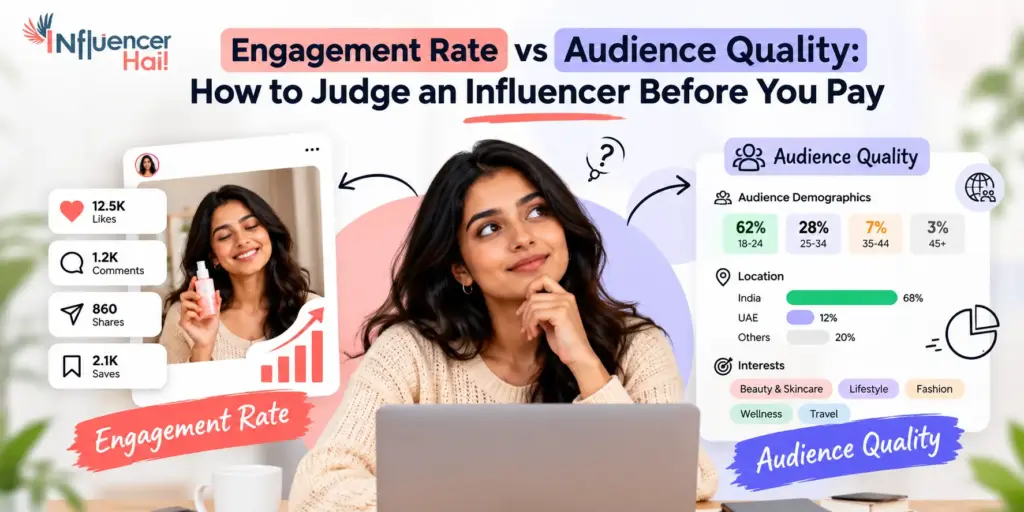
A creator with a great engagement rate can still be a poor investment. The likes and comments look impressive in the report, but if the people behind them live in the wrong city, belong to the wrong age group or have no interest in your category, sales barely move.
That is why so many influencer campaigns look successful on the surface and still miss their business goal. Brands trust one number and skip the question that matters more: who is actually engaging with this creator?
In this guide, you will learn how engagement rate and audience quality differ, how to check both before you pay, and a simple three-step method to choose creators who bring customers, not just likes.
Audience quality decides who is in the room. Engagement rate shows whether they are listening. Campaign results prove whether they act.
So use audience quality to shortlist creators, engagement rate to validate them, and results to decide who deserves your next budget.
Engagement rate shows how much interaction a creator’s content earns compared with the size of their audience. Interactions usually include likes, comments, shares, saves and sometimes video views.
The most common formula is:
Engagement Rate = Total Engagements ÷ Followers × 100
A reach-based version is also widely used, especially for Reels and Stories:
Engagement Rate (by reach) = Total Engagements ÷ Reach × 100
The reach-based version is often more useful for short videos, because it measures how people responded among those who actually saw the content, not among everyone who follows the account. Platforms and analytics tools calculate engagement in different ways, so always check which method is being used before you compare two creators.
Engagement rate shows how much interaction happened. It does not show who interacted. A creator can have a strong rate and still attract people who will never buy your product, such as followers from outside your target region or an audience that follows only for entertainment.
Some engagement is not genuine. Watch for:
A viral creator is not automatically the right creator.
Audience quality describes how closely a creator’s followers match the people you want to reach, and whether those followers are real and active.
Follower count shows how many people followed at some point. It does not show how many are relevant, real or paying attention today. A large account with a mismatched audience can cost more and deliver less than a smaller one built around the right community.
Instead of judging a creator on one number, move through three stages in order.
Start with the audience, before you look at engagement figures.
Remove creators whose audience does not match your customer. This keeps the rest of the work focused.
Key takeaway: If the audience is wrong, no engagement rate can fix it.
Now that the audience looks right, check whether it is paying attention.
Key takeaway: Consistent, real conversation beats one viral spike.
The final check is how the creator performs when promoting a product.
Key takeaway: The best predictor of a good campaign is how the creator’s audience reacted to a past one.
| Factor | Engagement Rate | Audience Quality |
| What it measures | How audiences interact with content | How relevant and real the audience is |
| Main focus | Content response | Fit with your target customer |
| Easy to check? | Fairly easy | Needs deeper analysis |
| Can it be manipulated? | Yes, through pods and purchased activity | Yes, through fake followers |
| Best use | Validating attention | Evaluating creator fit |
| Role in selection | Second check | First filter |
No single formula suits every campaign. The right balance depends on what you want to achieve.
For awareness, you want a relevant audience that is large enough to create visibility. Focus on reach, relevant audience size, video views and engagement. A creator with strong engagement and a broad but suitable audience works well here.
A launch needs both attention and the right people. Prioritize audience relevance and reach, then check content quality and engagement. Creators who can explain or demonstrate a new product clearly tend to perform better than those who simply post a mention.
Lead campaigns depend on the audience being able and willing to act. Audience quality carries the most weight, especially location and purchase intent. Track clicks and leads, not just likes.
For sales, relevance and conversion history matter most. Look at past click-through rates, sales results and return on investment. High engagement means little if it has never turned into purchases.
Here is how this plays out in practice. The numbers below are an illustration, not industry benchmarks.
Imagine a skincare brand targeting women aged 22 to 35 in metro cities, with budget for only one creator.
| Creator A | Creator B | |
| Followers | 250,000 | 80,000 |
| Engagement rate | 7% | 4.5% |
| Audience that matches the target | 15% | 75% |
| Relevant followers | about 37,500 | about 60,000 |
Creator A looks stronger at first glance, with a bigger following and a higher engagement rate. But only about 15% of that audience fits the brand. Creator B reaches about 60,000 relevant followers, and the people engaging are more likely to be potential customers.
For a targeted campaign, Creator B is probably the better choice. Creator A could still suit a broad awareness push. The lesson is that follower count and engagement rate alone cannot make this decision. Audience fit has to come first.
Not sure which creators fit your brand? Talk to an influencer marketing agency that analyzes audiences and shortlists creators for you.
Save this list for your next shortlist.
India’s creator landscape adds a few factors worth checking.
Judging audience quality takes time, and the checks above are easier with the right support. At InfluencerHai, our team handles creator discovery, audience analysis and shortlisting, so you start with creators who already fit your customer.
We also help brands plan campaign strategy, match creators to their goals, manage collaborations and track performance from the first post to the final report. That way, your decisions rest on audience fit and real results, not on surface numbers.
Engagement rate and audience quality are not rivals. Audience quality gets a creator onto your shortlist, engagement rate confirms the audience is paying attention, and campaign results show whether the partnership is worth continuing.
If you want help choosing creators who fit your brand and your goals, explore our influencer marketing services or get in touch with the InfluencerHai team.