Having great UGC content is only half the battle. A brand can hire the right creators and still end up with a video that gets views but no sales. The gap between UGC that performs well organically and UGC that actually converts as a paid ad comes down to a handful of specific, learnable techniques. This guide walks through exactly what separates a high-converting UGC ad from one that just sits there.
A high-converting UGC ad is one that moves a viewer from watching to acting, whether that action is a click, a sign-up, or a purchase, at a rate noticeably above the account or category average. This is different from a video that simply gets a lot of views or likes. A UGC ad can go viral organically and still convert poorly, because the two outcomes are driven by different things: reach is about the hook and shareability, conversion is about trust, clarity, and a clear next step. Picking the best ad format for the platform is the starting point, but the techniques below are what actually turn that format into a converting ad.
Every high-converting UGC ad shares one trait: it earns attention immediately, before the viewer has a chance to scroll past. A strong opening usually does one of three things. It names a specific problem the viewer already has, it shows a surprising or unexpected visual, or it makes a bold, specific claim that begs to be verified. Openings like “I almost didn’t buy this because” or a close-up product shot with immediate visible results tend to outperform a generic greeting or a slow product introduction. If a brand only fixes one thing about an underperforming UGC ad, the first three seconds are almost always where to start.
UGC ads that convert well are structured around a problem the viewer relates to, not a list of product features. A skincare ad that opens with “My skin used to break out every time I traveled” connects immediately with anyone who has had that exact experience. An ad that opens with “This serum contains niacinamide and hyaluronic acid” speaks to ingredients, not to a feeling the viewer recognizes in themselves. Features matter, but they work best as supporting proof after the problem has already been named, not as the opening line.
Paradoxically, UGC ads that feel the least like an ad tend to convert the best. Viewers have become skilled at recognizing a scripted read, even from an unpolished-looking video, and that recognition creates distrust rather than persuasion. The strongest UGC ads let the creator explain the product benefit in their own words, based on a clear brief rather than a fixed script. A slightly imperfect delivery that sounds like a real person talking almost always outperforms a technically flawless read that sounds rehearsed.
A large share of viewers watch video ads with the sound off, especially in the first few seconds before deciding whether to engage. High-converting UGC ads are built to make sense visually and through captions alone, with sound as a bonus layer rather than a requirement. This means captions should carry the core message, on-screen text should highlight the key benefit or offer, and the visual itself should communicate what is happening even without narration. Ads that rely entirely on spoken explanation often lose a meaningful share of potential conversions simply because the message never reaches a muted viewer.
A UGC ad without a clear next step relies on the viewer to figure out what to do on their own, and most will not bother. The strongest UGC ads state the action directly, whether that is “link in bio,” a specific promo code, or a spoken instruction like “tap the link to get twenty percent off.” Vague endings, such as simply showing the product one more time, consistently convert worse than a direct, specific instruction repeated both visually and verbally near the end of the video.
Not every high-converting UGC ad looks the same, because the right approach depends on how familiar the audience already is with the brand.
| Funnel Stage | Best UGC Approach | Why It Works |
| Cold audience | Problem-solution hook, fast value | Viewer has no context, needs quick relevance |
| Warm audience | Comparison or demo-style content | Viewer is aware, needs proof it works |
| Retargeting | Testimonial with specific results | Viewer is close to buying, needs reassurance |
Running the same UGC ad across all three stages usually underperforms compared to tailoring the opening and message to where the viewer actually is in their decision process.
Even a well-built UGC ad following every principle above will not automatically be the best performer. High-converting UGC ad strategies are built through testing multiple hooks, creators, and formats against each other, then scaling whichever version performs best. A useful starting approach is testing three different opening hooks with the same core message, since the hook alone often accounts for the biggest swing in performance between two otherwise similar ads. Brands that test consistently, even in small batches, tend to build a much stronger sense of what actually converts for their specific audience than brands that produce one video and hope it works.
A few recurring mistakes show up again and again in UGC ads that fail to convert. Overloading the video with too many product benefits at once dilutes the core message instead of strengthening it. Using a creator who does not naturally fit the product category creates a subtle credibility gap, even if the script is well written. Skipping captions loses a meaningful share of muted viewers before the message even lands. And ending the video without a clear, repeated call to action leaves conversion entirely up to chance rather than direction.
Beyond the creator’s own testimony, high-converting UGC ads often layer in small, believable social proof cues directly within the video. This could be an on-screen mention of how many units have sold, a quick flash of genuine customer reviews, or the creator referencing that a friend recommended the product to them first. These details work because they answer an unspoken question every viewer has: is this actually good, or is this creator just being paid to say so? A brief, honest social proof moment, even something as simple as “this is my third time reordering,” does more to build trust than repeating product benefits a second time.
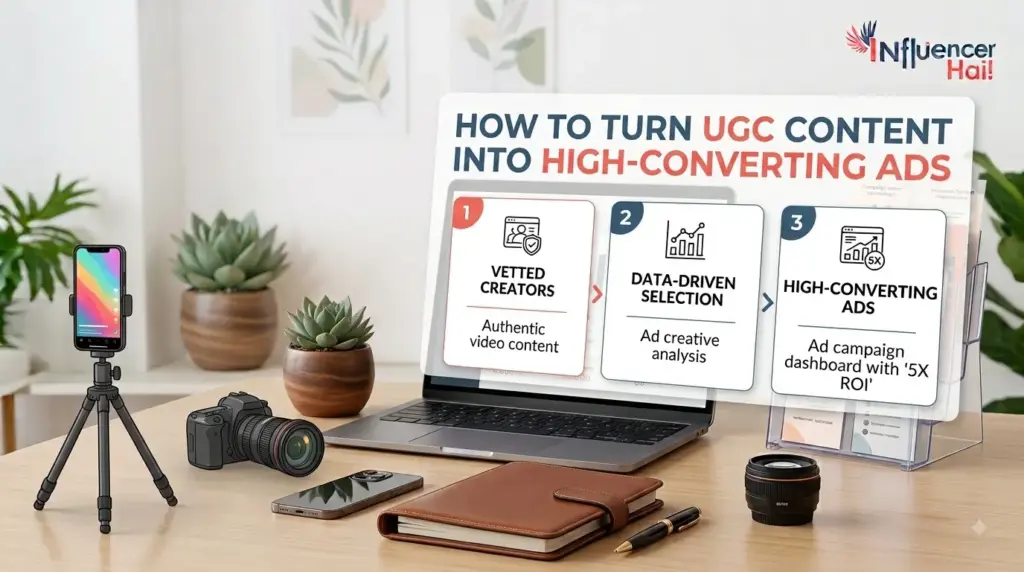
High-converting UGC ads are not the result of luck or a single viral moment. They are built through a repeatable process: a strong opening hook, a problem-first structure, an authentic creator voice, silent-friendly design, a clear call to action, and consistent testing against real performance data. Brands that treat UGC ad creation this way, as a system rather than a one-off shoot, consistently see stronger results over time than those chasing a single perfect video.
Working with an experienced influencer marketing agency can help apply these conversion principles consistently across every campaign. For brands focused specifically on UGC, partnering with a dedicated UGC agency ensures the right creators and formats are matched to each ad from the start, turning good content into content that actually grows a business.
If building and testing this system feels like more than your team has time for, get in touch with our team at InfluencerHai and we will help you plan, produce, and optimize UGC ads that convert, not just perform well on views.