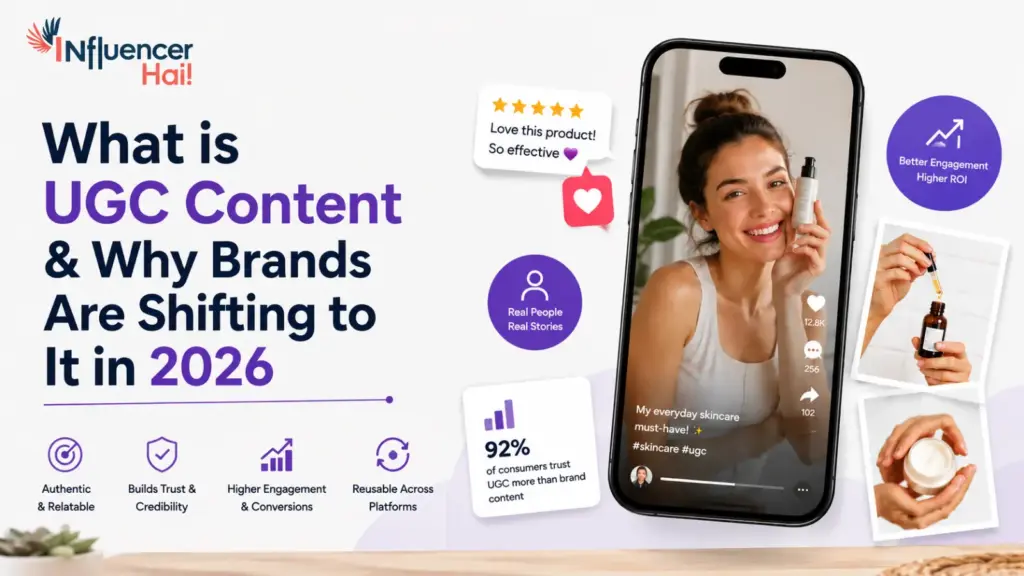
If you have been noticing more raw, phone-shot videos in your Instagram feed lately and fewer polished studio ads, you are not imagining it. UGC content creation has quietly become one of the biggest shifts in Indian digital marketing, and in 2026, it is no longer a side experiment. It is the main strategy for brands that want to be trusted, not just seen. So what is UGC content exactly, and why are so many brands moving their budgets toward it?
UGC stands for User-Generated Content. In simple terms, it is content that looks like it was made by a real customer, not a brand’s marketing team. Think of a person filming themselves unboxing a skincare product in their bedroom , or a home cook trying out a new snack brand in their own kitchen. No fancy lighting, no scripted lines, just a real person sharing a real experience.
This is different from traditional influencer marketing in one key way. Influencer marketing is about reach and personality. UGC is about believability. When a real person says “I tried this and it worked,” it lands very differently than a brand saying “our product is amazing.” One feels like a recommendation from a friend. The other feels like an ad.
There are a few clear reasons this shift is happening right now, and they are backed by real numbers, not just trend talk.
People trust people, not polished ads. Indian audiences today spend a huge part of their day on social media, and they are increasingly scrolling past anything that looks too “branded.” Industry research has found that UGC has a far bigger impact on purchase decisions than traditional branded content, simply because it feels honest.
It costs less and delivers more. This is the part that gets a brand’s finance team excited too. A professional studio shoot can easily cost anywhere from ₹15,000 to ₹60,000 per video. UGC content, on the other hand, typically costs between ₹500 and ₹15,000 per video. That means a brand can get four to ten times more content for the same budget, without sacrificing performance. In fact, UGC often performs better in ads because it does not look like an ad at all. For a full breakdown of what drives these numbers, check out our complete UGC content pricing guide.
It is built for how people actually shop now. Instagram Shops, YouTube Shopping, and similar features mean people are increasingly buying directly from the content they are watching. UGC fits naturally into this because it feels like a recommendation in the moment, not an interruption before the moment.
Regional and vernacular content is winning trust. One of the biggest shifts happening in 2026 is brands working with creators who speak in regional languages, not just English or Hindi. A UGC creator speaking a customer’s own language, in their own cultural tone, builds a kind of trust that a single national campaign simply cannot replicate.
AI is making UGC faster to produce, not fake. Brands are now using AI tools to help write briefs, suggest hooks, and speed up production planning. This does not replace the real creator on camera. It just means campaigns can move faster and briefs can be sharper, which is a big deal for brands trying to keep up with content demand.
Not all UGC looks the same, and knowing the different formats helps in planning a proper content mix instead of relying on just one type of video.
For UGC video ads specifically, short-form content built for Instagram Reels, YouTube Shorts, and Meta ad placements tends to outperform longer formats, simply because attention spans on these platforms are short and the first three seconds decide whether someone keeps watching.
This is probably the most common follow-up question that comes up right after “what is UGC.” The honest answer is that they solve different problems.
If you’re comparing UGC vs Influencer Marketing, it’s important to understand that each serves a unique purpose in a successful marketing strategy.
Influencer marketing works well when a brand wants reach, credibility through a known face, and access to a loyal existing audience. UGC works best when a brand wants authentic, high-converting ad content that can be reused across paid ads, product pages, and social feeds. Many of the smartest brands today are not choosing one over the other. They are using UGC creators to produce raw, trust-building content, while using influencers separately for reach and brand storytelling. Used together, the two approaches cover both halves of the funnel awareness and conversion.
It helps to think of UGC not as a single tactic, but as content that can be reused across an entire customer journey.
At the top of the funnel, short UGC clips work well as scroll-stopping paid ad creative, since they blend into a feed instead of interrupting it. In the middle of the funnel, testimonial and comparison-style UGC helps a hesitant buyer trust a product enough to click through to a website or product page. At the bottom of the funnel, UGC placed directly on product pages, next to reviews, gives a final nudge to someone who is already close to buying but wants one more bit of reassurance.
This is why a growing number of brands are no longer treating UGC as a single ad campaign. They are treating it as an ongoing content engine that feeds paid ads, organic social, and even the website itself, all from the same pool of creators.
If a brand is considering UGC content creation for the first time, here is what actually matters when choosing who to work with:
UGC is not a passing trend. It is becoming the backbone of how Indian brands build trust online, and the brands that start now are the ones building a genuine content advantage before it becomes standard practice. The shift is not about abandoning influencer marketing altogether, but about pairing it with authentic, creator-made content that converts. Whether a brand already works with an influencer marketing or is exploring one for the first time, getting the UGC strategy right early will save both budget and time down the line. If you are ready to start building authentic, high-converting UGC content for your brand, get in touch with our team at InfluencerHai and we will help you find the right creators and the right strategy from day one.