A brand asks an AI tool for twenty creator scripts, sends them all out, and gets back twenty stiff videos that sound exactly alike. The tool did what it was asked to do. The workflow around it did not. Generative AI in influencer marketing is useful, but only when it supports creators and marketers instead of replacing their judgment.
As an influencer marketing agency in India, we have seen brands get real speed from these tools, and we have seen them lose trust by overusing them. This guide covers where generative AI helps, where it should stay out, and how to build a workflow that keeps people in charge.
Generative AI refers to tools that create new text, images, audio or video from a prompt. In influencer marketing, that mostly means drafting briefs, ideas, captions, scripts, translations and ad variations that people then review and improve.
It helps to separate this from the rest of AI in the field. Discovery, fraud checks, matching and analytics belong to AI-powered influencer marketing, where AI analyzes data. Generative AI is different because it produces content, so the risks are about accuracy, tone and authenticity, not just data quality.
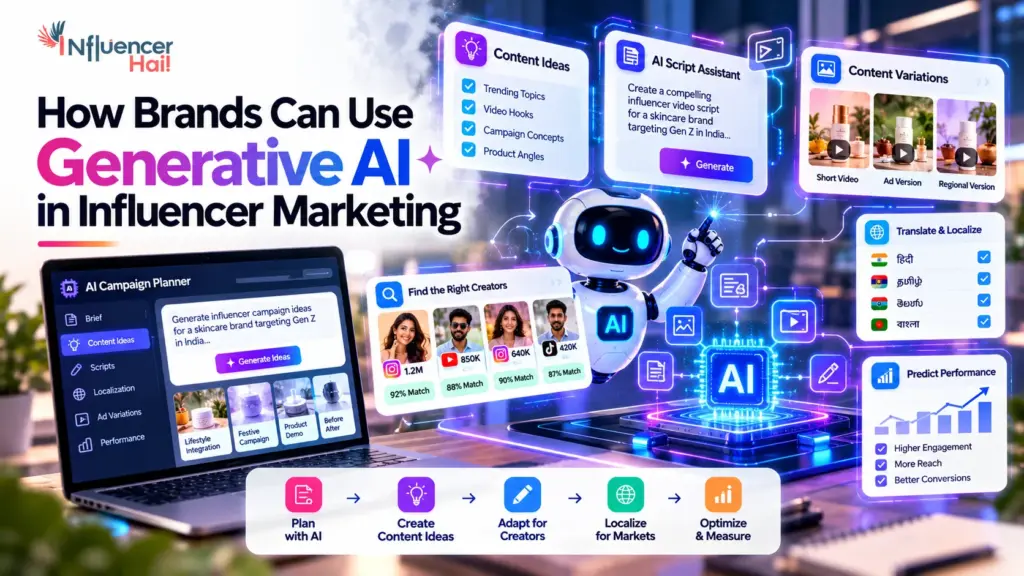
A campaign brief is the best place to start, because it is mostly structure. Give an AI tool your goal, audience, product facts, platforms, deliverables and deadline, and it can produce a clean first draft with the sections in a sensible order. It can also shrink a long internal document into a one-page version that creators will actually read.
What it cannot do is know your brand. A person has to add the must-say points, claims to avoid, disclosure requirements, usage rights, tracking links and approval steps. A brief written entirely by AI tends to be generic, and creators notice.
Good influencer campaign management still depends on a person owning the final brief, the approvals and the relationship with each creator.
AI is good at volume. Ask for fifteen hook options for a skincare launch, ten angles for an app demo or a list of questions an audience might ask, and you will have material to react to in minutes. Treat that as a brainstorm, not a finished plan.
Scripts need more care. Instead of asking for a full script, ask for talking points and a loose structure, then let the creator turn them into their own words. Creators earn trust by sounding like themselves, and a script read word for word usually shows. UGC content works for the same reason: it feels natural, not written.
To adapt ideas for each creator, share what you know about their style, such as pace, humor and the kind of products they usually show, and ask for a different angle for each one. Then send the result as a suggestion, not an instruction. An influencer marketing agency will usually run this step as a conversation with the creator, because the best version often comes from the discussion.
Regional languages are where generative AI can save the most time and also do the most damage. Tools can draft a first version of a Hindi, Tamil, Bengali or Marathi message quickly, which helps when you are briefing creators across several markets.
The risks are real, though. Machine drafts can sound formal, miss local expressions, mishandle mixed languages such as Hinglish, or get product terms wrong. Always have a native speaker review the language, and let the creator adjust it to the way they actually speak. If you are planning several languages at once, our guide to multilingual influencer campaigns explains how to localize briefs instead of translating them.
Once a creator video is performing, generative AI can help you test it as an ad. It can suggest alternative hooks, headlines, captions and calls to action, and it can summarize comments to show which questions and objections viewers raise. That gives your media team more variations to test without starting from zero.
The process of choosing, authorizing and running creator content as ads is a separate topic, and our step-by-step guide shows how to turn influencer content into paid ads.
One rule matters here: AI edits do not remove the need for permission. If AI tools are used to cut, caption, translate or alter a creator’s video or voice, the agreement must allow it. Check your influencer usage rights before any AI-assisted change goes live, and never change what a creator appears to say without their approval.
Some parts of influencer marketing should stay with people:
The main risks of AI-generated content fall into four groups:
Fully synthetic creators are a different question again, and we cover it in our guide to AI influencers in India.
This is why a person, whether an in-house lead or an influencer marketing agency, should sign off on every piece of content before it goes live.
A simple workflow keeps AI useful and safe:
Here are three sample prompts to adapt. They are examples, so replace the placeholders with your own details:
Draft a one-page influencer brief for [product] aimed at [audience]. Include the objective, key message, three must-say points, deliverables and a deadline. Keep it under 300 words.
Give me 10 hook options for a 30-second Instagram Reel about [product], in a casual tone, with no exaggerated claims.
Rewrite this brief in simple Hindi that a creator would use in conversation. Keep brand terms in English.
Do not paste confidential contracts, creator rates or customer data into public AI tools.
Many brands work with an best influencer marketing agency in India to set up this workflow, so briefs, reviews and approvals sit in one place.
Do not assume AI saves time or money. Measure it against a baseline. Useful measures include:
Run a small pilot across two or three campaigns before drawing conclusions, and look at quality as well as speed. If AI saves hours but creators push back on the briefs, the saving is not real.
Generative AI in influencer marketing works best as an assistant. It drafts, suggests and speeds things up, while people decide, adapt and approve. Start with briefs and ideas, let creators keep their own voice, check every regional and paid-ad adaptation, and measure the effect against a baseline. If you want to build that workflow with a partner, InfluencerHai can set it up with you, so get in touch with our team to plan your next campaign.