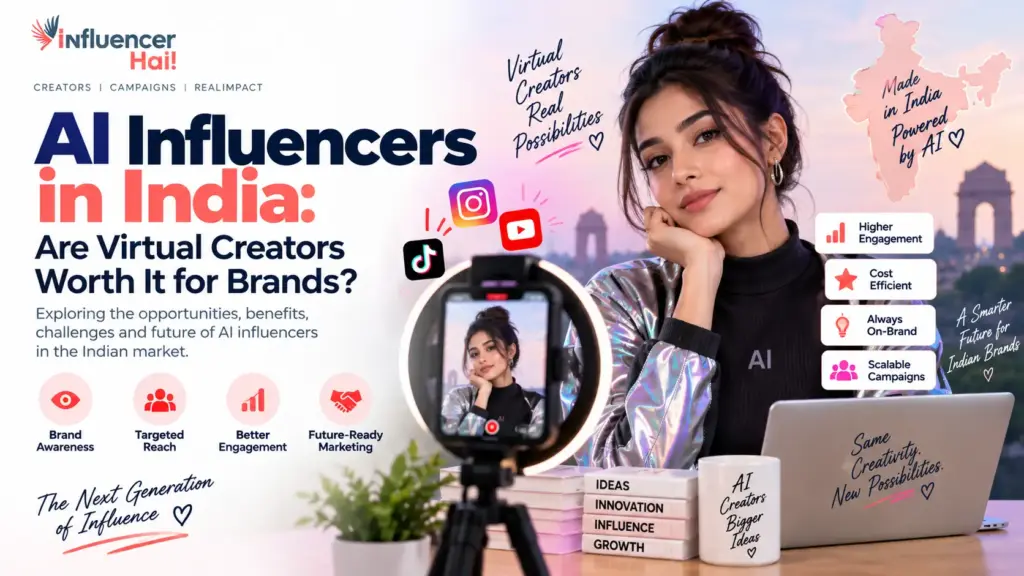
AI influencers are having a real moment in India. Digital personas built entirely with computer graphics and artificial intelligence are racking up followers, landing brand deals, and showing up in the same conversations as human creators. Kyra, one of India’s earliest virtual influencers, built a following in the hundreds of thousands and continues to work with brands looking for something different. Naturally, this raises a question every marketer is now asking: should brands be putting budget behind AI influencers instead of real ones?
It is a fair question, and the honest answer is more nuanced than a simple yes or no. AI influencers genuinely have a place in modern marketing, but they are not a replacement for the kind of trust that real social media influencers build with their audiences. This article breaks down what AI influencers actually are, where they work well, where they fall short, and how brands should think about fitting them into a broader creator marketing strategy.
An AI influencer is a fully digital persona, created using computer-generated imagery and artificial intelligence tools, designed to look, speak, and post like a real content creator. Unlike a real person, an AI influencer has no physical existence. Every photo, video, and caption is generated or heavily assisted by software, and a team behind the scenes manages the brand voice, posting schedule, and business deals on the persona’s behalf.
Some AI influencers are designed to look almost indistinguishable from real humans, while others lean into a clearly stylized, digital aesthetic. Either way, the appeal to brands is the same: complete creative control, no scheduling conflicts, no off-brand behavior, and a persona that can theoretically work around the clock without ever needing a day off.
There are a few real reasons brands are testing AI influencers rather than dismissing them outright.
Full brand control. Since an AI influencer is entirely brand-managed, there is no risk of the creator saying something off-message, getting involved in controversy, or deciding to work with a competitor. Every post can be planned and approved with total predictability.
Consistency at scale. An AI influencer’s appearance, tone, and messaging stay exactly the same across hundreds of posts, campaigns, and platforms, which appeals to brands running large, long-term influencer campaigns where consistency matters more than personality.
Novelty factor. For certain categories, particularly gaming, tech, fashion-forward, or futuristic product lines, an AI influencer’s very existence becomes part of the marketing story. Audiences engage with the content partly because it is an AI persona, which can drive curiosity-based engagement that a traditional creator post would not generate on its own.
Reusability. Once built, an AI influencer can be repurposed indefinitely across campaigns without renegotiating a new contract or rate every time, unlike ongoing creator partnerships with real influencers.
These are legitimate advantages, and they explain why some brands, particularly in tech and gaming, have found real value in virtual creators.
Despite these advantages, AI influencers run into a wall that no amount of technical polish can fully solve: authenticity.
The entire foundation of modern influencer marketing rests on trust. Audiences follow real creators because they believe a real person is sharing a real opinion, based on a real experience. This is exactly why influencer-generated content consistently outperforms traditional advertising, viewers feel like they are getting an honest recommendation rather than a sales pitch.
An AI influencer cannot genuinely have used a product, felt a fabric, tasted a meal, or experienced a service. No matter how convincing the visuals are, audiences generally know, or eventually learn, that they are engaging with a fully synthetic persona. For categories where trust is the entire point, skincare, health, finance, parenting, and food, this gap matters enormously. A recommendation from an AI persona simply does not carry the same weight as one from a real creator whose audience has watched them build a genuine relationship with their followers over time.
This is also where the difference between AI influencers and authentic UGC becomes obvious. UGC works precisely because it looks and feels unscripted, like a real person casually sharing their honest experience with a product. That rawness is what builds social proof and drives conversions, and it is fundamentally something an AI influencer cannot manufacture, no matter how advanced the technology gets.
| Factor | AI Influencers | Real Influencers |
| Authenticity | Fully brand-controlled, no real experience | Genuine, lived experience with the product |
| Audience trust | Lower, audiences often sense it’s synthetic | Higher, built on real relationships over time |
| Content consistency | Perfectly consistent every time | Varies with personality and mood |
| Cost over time | High upfront build cost, cheaper to reuse | Ongoing fees per campaign or partnership |
| Best for | Novelty, gaming, tech-forward campaigns | Trust-driven categories like beauty, food, finance |
| Conversion strength | Weaker for purchase decisions | Stronger, backed by real social proof |
| Scalability | Easy to scale across campaigns | Requires managing multiple real creator relationships |
| Regulatory risk | Low, fully controlled messaging | Moderate, depends on creator behavior |
The table makes the trade-off clear. AI influencers win on control and consistency, but real influencers win where it matters most for most brands: trust and conversions.
To be fair to the format, AI influencers are not universally weak. There are specific situations where they perform reasonably well:
Even in these cases, most brands find AI influencers work best as a supplement to a broader creator marketing plan, not as the entire strategy.
The smartest way to think about AI influencers is not “AI versus real creators,” but where each one earns its place in a wider plan. For most brands, especially those in trust-sensitive categories, the stronger long-term investment remains in real influencer campaigns, nano and micro influencers, and genuine creator partnerships that build a track record of authentic recommendations over time.
This is where working with an established influencer marketing agency makes a real difference. A good agency does not chase whatever is trending for its own sake, it builds a strategy around what will actually move your specific audience, whether that includes celebrity endorsement for scale, nano and micro creators for authentic engagement, or a UGC-driven approach for e-commerce conversions.
If AI does have a role to play, it is far more useful behind the scenes than in front of the camera. AI tools are already transforming how brands discover creators, analyze engagement rate data, predict campaign performance, and manage large-scale creator partnerships more efficiently. That is a very different use of AI than building a synthetic persona to replace a human voice, and it is where the technology adds real value without sacrificing authenticity. We cover this side of things in more depth in our guide on AI-powered influencer marketing, including how AI is used for creator discovery and campaign management rather than content generation.
Rather than treating AI influencers as a shortcut, the more useful question for most brands is how to build an influencer marketing strategy that uses the right mix of creators for the right goals. A few principles hold up regardless of where AI fits in:
Match the creator type to the goal. Awareness campaigns can tolerate more experimentation, including AI personas or bigger celebrity endorsement moments. Conversion-focused campaigns benefit far more from authentic, real-person content and social proof.
Don’t chase novelty over trust. An AI influencer might generate a short-term spike in curiosity, but sustainable brand growth still comes from consistent, trusted creator partnerships built over months and years, not a single viral moment.
Use AI as a tool, not a replacement. Let AI handle the operational heavy lifting, creator discovery, performance prediction, campaign management, while keeping real people at the center of the actual content and messaging.
Diversify across creator tiers. A strong social media marketing plan usually blends nano and micro influencers for authentic engagement, mid-tier creators for broader reach, and occasionally celebrity endorsement for major launches, rather than betting everything on one format, virtual or otherwise.
For a narrow set of use cases, novelty campaigns, gaming and tech categories, or highly controlled messaging environments, AI influencers can genuinely add value. But for the vast majority of brands, particularly anywhere trust, authenticity, and real conversions matter, real creators and genuine UGC still win decisively.
The technology is interesting, and it is not going away. But interesting is not the same as effective, and effective is still what most brands actually need. If you are weighing where AI fits into your own creator marketing plans, or want help building a strategy that balances real creator partnerships with smarter, AI-assisted campaign management, our team at InfluencerHai can help you figure out exactly where that balance should sit for your brand.