Barter collaborations have become one of the easiest ways for brands to work with creators without committing a full cash budget. Instead of paying a creator fee, the brand offers a product, service, or experience, and the creator produces agreed content in exchange. It’s a low-risk way to test social media influencer marketing, build a content library, and reach new audiences.
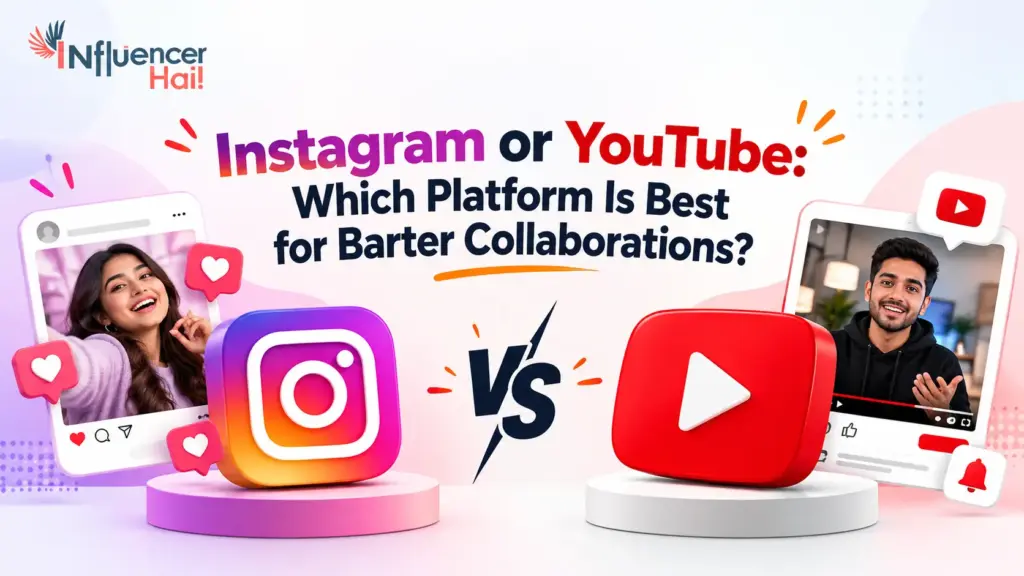
But once a brand decides to try barter, a practical question comes up fast: Instagram or YouTube? The honest answer is that neither platform is universally better. The right choice depends on your product, your campaign goal, how much effort you’re asking a creator to put in, and what kind of content you actually need. This guide breaks down how the two platforms differ for barter specifically, so you can make that call with more than a guess.
A barter collaboration is a non-cash exchange: the brand provides a product, service, or experience, and the creator provides agreed content in return. There’s usually no standard cash payment involved, or only a small cash component layered on top of the product.
The basic flow looks like this:
Product → Creator → Content → Audience → Brand
A few things matter for this to work well:
It’s also worth knowing where barter sits relative to other collaboration types:
| Factor | YouTube | |
| Content format | Reels, Stories, Posts | Shorts, Reviews, Long-form videos |
| Production effort | Usually lower | Usually higher |
| Content speed | Faster | Slower |
| Product discovery | Strong visual discovery | Strong search discovery |
| Content lifespan | Often shorter | Can stay discoverable for months or years |
| Best for | Visual, quick campaigns | Detailed demonstrations |
| Creator effort | Lower to moderate | Moderate to high |
This table is a useful starting reference, but the sections below go deeper into why each of these differences actually matters for a barter deal specifically.
Instagram tends to be the easiest entry point for brands testing barter collaborations, for a few concrete reasons:
Visual, easy-to-demonstrate products tend to perform best here:
YouTube changes the equation. It’s not simply “Instagram, but longer”:
Because YouTube content generally requires more planning, filming, and editing than a typical Instagram Reel, the product’s value and the agreed deliverables need to genuinely make sense for the time a creator is putting in.
Products that benefit from explanation, demonstration, or long-form context tend to do better here:
Rather than treating this as a single either-or decision, it helps to break it down by scenario.
Choose Instagram when:
Choose YouTube when:
Use both when:
This mirrors a broader point worth keeping in mind throughout: platform choice should follow your campaign goal, not the other way around. Neither platform is strictly superior, they’re suited to different jobs.
A simple four-step framework helps take the guesswork out of this decision:
| Industry | Suitable Platform | Content Format |
| Beauty | Reel, Story, Tutorial | |
| Fashion | Reel, Styling, Try-on | |
| Food | Reel, Visit, Review | |
| Jewellery | Styling, Product showcase | |
| Technology | YouTube | Review, Unboxing |
| Gaming | YouTube | Gameplay, Review |
| Software | YouTube | Tutorial, Demo |
| Education | YouTube | Explanation, Review |
| Travel | Both | Reel + Vlog |
| Fitness | Both | Reel + Detailed Review |
Treat this as a practical starting point rather than a fixed rule, creator and audience fit still matter more than industry alone.
A barter deal runs smoothly when a few things are agreed upfront:
Product or experience: be specific about exactly what the creator receives.
Deliverables: spell it out clearly, for example, 1 Instagram Reel, 2 Stories, or 1 YouTube video plus a Short.
Timeline: when content needs to go live, not just when the product ships.
Content usage rights: can the brand reuse this content on its own website, social pages, paid ads, or marketplace listings, and for how long? This should be settled before the campaign starts, not after.
Disclosure: make sure the collaboration is properly disclosed, in line with applicable advertising rules and each platform’s own requirements.
Choosing creators only by follower count. A large following means little if the audience isn’t genuinely relevant to your product.
Offering the same deal to every creator. Effort varies significantly by platform and format, a flat, one-size-fits-all offer usually undervalues some creators and overpays others.
Not defining deliverables clearly. “Post about our product” invites disappointment on both sides. Specify format, quantity, and timing upfront.
Ignoring content usage rights. This becomes a real problem later if the brand wants to reuse creator content in paid advertising and never secured the rights to do so.
Sending products without tracking anything. Keep a simple record of the creator, the product sent, delivery status, content status, the published URL, and basic performance numbers, reach, engagement, and any conversions. Without this, it’s hard to know what actually worked, which is where working with a top barter influencer marketing agency tends to save the most time.
Running one barter deal is manageable on your own. Running a dozen across two platforms, with different creators, different deliverables, and different timelines, gets complicated fast.
Our process covers the full cycle: Campaign Brief → Creator Discovery → Creator Matching → Outreach → Product Coordination → Content Management → Campaign Tracking → Reporting. That includes influencer discovery and matching, Instagram and YouTube campaign management, and performance reporting tied back to your original goals, so you’re not juggling spreadsheets and DMs across platforms yourself.
Looking to run a barter influencer campaign in India? Connect with InfluencerHai to discuss your campaign requirements.
The right platform for a barter collaboration depends on your campaign objective, product type, creator effort, audience, and content requirements. Instagram works well for fast, visual, high-volume campaigns, while YouTube suits products that need detailed demonstration or benefit from long-form, search-driven content. For some campaigns, combining both platforms gives you broader coverage than either one alone.