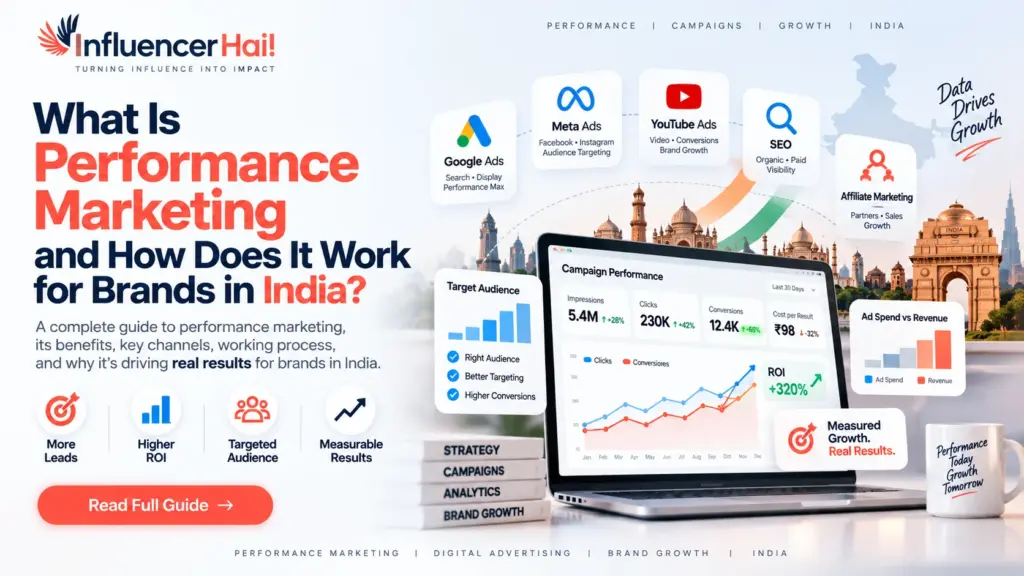
Imagine paying for an ad only when it actually works, when someone clicks, signs up, or buys. That’s the whole idea behind performance marketing, and it’s why more Indian brands are shifting their budgets toward it every year. As an influencer marketing agency that also runs paid campaigns daily, we see this shift firsthand in how brands plan their budgets today.
Traditional advertising asks you to pay upfront and hope for the best. A billboard costs the same whether ten people notice it or ten thousand. Performance marketing flips that. You pay based on results, not just visibility. That single difference is reshaping how brands in India spend their marketing budgets, and it’s worth understanding properly before you put money behind it.
Performance marketing is a type of performance-based advertising where you only pay when someone takes a specific action. That could be a click, a form submission, a sign-up, or an actual sale.
Instead of guessing whether an ad “worked,” performance marketing runs on real data. Every click, every conversion, every rupee spent is tracked. This means brands can see exactly what’s working and adjust in real time, rather than waiting weeks to find out a campaign flopped.
Here’s what a typical performance marketing campaign actually looks like, step by step:
Setting campaign objectives comes first. Do you want more website visits, more leads, or more sales? This decision shapes everything that follows.
Identifying the target audience means figuring out exactly who should see your ads, based on age, location, interests, or past behavior.
Selecting suitable digital channels is about picking where your audience actually spends time, Google, Instagram, YouTube, or a mix.
Creating and launching campaigns brings the strategy to life, with ad creatives, targeting, and budgets all set up before going live.
Tracking campaign performance happens continuously, not just at the end. Every click and conversion gets logged.
Optimizing campaigns based on results is where the real value shows up. Underperforming ads get paused or changed, while winning ads get more budget.
Google Ads campaigns are great for catching people who are already searching for something specific. This includes search campaigns (text ads on search results), display advertising (visual ads across websites), and shopping campaigns (product listings for e-commerce).
Meta Ads cover both Facebook advertising and Instagram advertising, two of the most widely used platforms in India. These work especially well for lead generation and conversion campaigns, since targeting options are incredibly detailed.
YouTube advertising is ideal for video campaigns, particularly for awareness and consideration campaigns where showing your product in action matters more than a static image.
Beyond Meta, paid social media advertising extends across other relevant platforms too, combined with strong audience targeting and retargeting to re-engage people who’ve already shown interest.
Affiliate marketing is a partner-based promotion model, where you pay publishers or creators only for measurable results, like a sale or sign-up they directly generate.
Numbers matter a lot in performance marketing. Here are the ones you’ll see most often:
These performance marketing metrics are what separate performance marketing from guesswork. Every decision can be backed by a number.
Why are so many brands leaning into this approach? A few clear reasons:
Performance marketing isn’t one-size-fits-all. Here’s how it plays out across different business types:
E-commerce brands rely heavily on e-commerce performance marketing to drive product sales directly, often through Google Shopping and retargeting.
Startups use it to test ideas quickly and cheaply before committing to bigger, more expensive marketing bets.
D2C companies depend on performance marketing for D2C brands to acquire customers efficiently, since every rupee of acquisition cost matters when margins are tight.
Local businesses use geo-targeted ads to reach people in their specific city or neighborhood.
Education and healthcare brands generate leads for admissions or appointments through targeted lead generation campaigns.
Real estate brands use performance marketing to drive site visit bookings and qualified property inquiries.
B2B businesses rely on it for lead generation, often through LinkedIn and search campaigns targeting decision-makers directly.
Running all of this well takes real expertise, which is why many brands turn to a performance marketing agency instead of managing it alone. Here’s what a good agency actually handles:
Here’s where things get interesting. Performance marketing and influencer marketing work even better together than either does alone.
Brands increasingly combine paid advertising with creator content, since audiences trust a creator’s voice more than a traditional ad. This means using influencer-generated content directly inside paid campaigns, rather than treating influencer marketing and performance marketing as two separate budgets.
A common approach: take a creator’s best-performing organic post from an influencer marketing campaign, and turn it into a paid ad running to a much wider, targeted audience. This is often called boosting or whitelisting, and it lets brands scale what’s already proven to work.
Retargeting audiences who’ve already engaged with influencer content, but haven’t purchased yet, is another powerful tactic. It connects the awareness a creator builds with the actual conversion a performance campaign is designed to drive. Even a celebrity endorsement in India campaign can be amplified this way, taking a high-reach celebrity moment and retargeting the audience it generated with a focused, conversion-driven ad.
This blended approach is exactly how InfluencerHai’s CRED campaign worked, turning organic creator content into a paid strategy that drove real, measurable app growth.
If you’re starting from scratch, here’s a simple path to follow:
This is the same digital marketing strategy framework that underpins most successful performance marketing agency engagements, structured, data-led, and never static.
A few mistakes show up again and again, even with experienced marketers:
Avoiding these mistakes often matters more than any clever targeting trick.
Performance marketing gives Indian brands something traditional advertising never could: a clear, measurable way to see exactly what’s working and what isn’t. It rewards testing, data, and continuous optimization over guesswork and big upfront bets.
Whether you’re running Google Ads campaigns, Meta Ads, or blending paid social media advertising with an influencer marketing campaign, the goal stays the same, turning ad spend into real, trackable business outcomes.
As a full-service influencer marketing agency that also blends in social media influencer marketing, InfluencerHai helps Indian brands combine both worlds, creator-driven content and data-backed paid strategy, into campaigns built for measurable growth, not just visibility.