If you’ve started looking for an influencer marketing agency in India, you’ve probably noticed something frustrating: almost every agency’s website says the same thing. They all promise a “huge creator network,” “authentic engagement,” and “measurable ROI.” Pitch decks look polished, case study numbers look impressive, and every sales call sounds confident. On paper, most agencies genuinely do look interchangeable.
The real differences only show up once a campaign is already underway, when creators don’t deliver on time, reports turn out to be surface-level, or content usage rights become a dispute nobody discussed upfront. By then, your budget is already spent, and switching agencies mid-campaign is far more disruptive than choosing carefully the first time.
This guide is built to close that gap. Instead of generic advice like “check their reviews” or “look at their portfolio,” it gives you a practical framework: specific factors to evaluate, questions to ask before signing anything, red flags that are easy to miss in a confident pitch, and a way to actually compare multiple agencies side by side using the same brief. Whether you’re hiring an agency for the first time or replacing one that didn’t work out, the goal here is the same: helping you judge an agency by what it can actually prove, not just what it promises.
Before comparing agencies, it helps to know what you’re actually paying for. A good influencer marketing agency typically handles:
If an agency only does one or two of these well, you may end up doing the rest yourself, which defeats much of the point of hiring one in the first place.
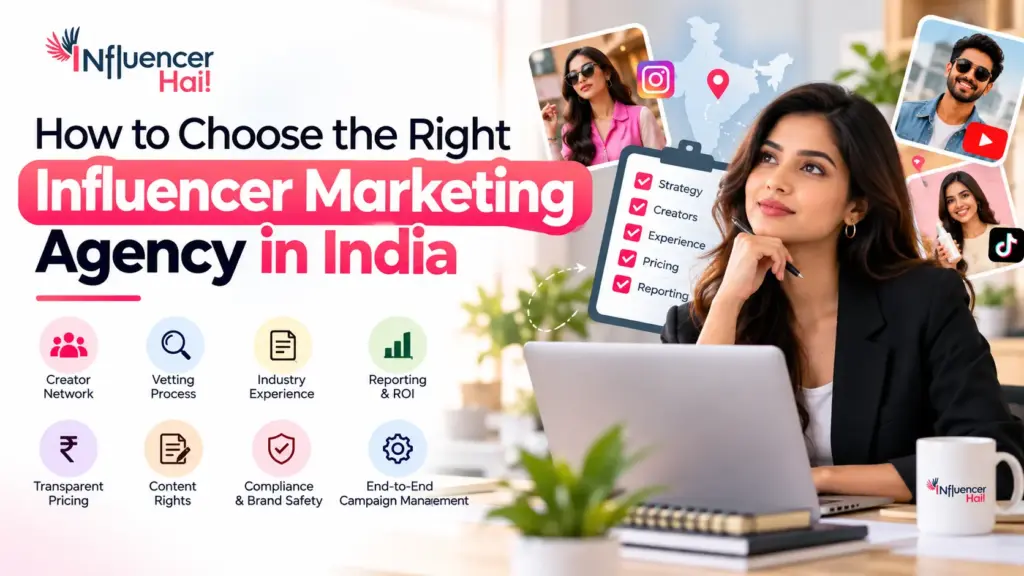
A big number sounds impressive, but size alone doesn’t mean much. What matters is whether the agency has creators who are actually relevant to your industry and audience. A network of 500,000 creators is only useful if a meaningful chunk of them fit your brand. For example, if you sell skincare products, an agency with thousands of tech reviewers isn’t helpful to you, no matter how large their overall network is. Ask the agency to show you creators specifically from your category, not just an overall headline number.
Ask how the agency checks for fake followers and bought engagement. A serious agency looks at engagement rate, audience location, and follower growth patterns, not just follower count. In practice, this means checking whether a creator’s followers actually match your target market’s location and age group, and whether their engagement has grown naturally over time rather than spiking suddenly, which can be a sign of purchased followers.
An agency that has run campaigns in your industry (finance, beauty, automobile, FMCG) will already understand your audience and the kind of content that works. Ask to see case studies from a similar sector. An agency that’s mostly worked with fashion and lifestyle brands may struggle to find the right tone for a fintech product, where trust and compliance matter more than aesthetics.
Watch out for agencies that jump straight to sending you an influencer list before understanding your goals. A good agency starts with your objective, then selects creators to match it, not the other way around. If your goal is app downloads, your creator mix should look very different than if your goal is broad brand awareness, and an agency worth hiring should explain that difference clearly before recommending names.
Find out exactly what’s included. Some agencies only connect you with influencers and leave the rest to you. Others manage the full process, briefing, content approval, posting, and follow-up, so you’re not chasing creators yourself. If you have a small internal team, this distinction matters a lot, since managing dozens of individual creator relationships on top of your regular job is time-consuming.
A trustworthy agency will clearly break down what you’re paying for: creator fees, agency fees, content usage, and any extras. Vague, bundled pricing with no breakdown is a common source of disputes later. Ask for an itemized quote rather than a single lump sum, so you know exactly how much is going to creators versus the agency’s own service fee. If you want a clearer sense of what these costs typically look like across different campaign types, our influencer marketing cost guide breaks down pricing in more detail.
This one gets overlooked often. Can you reuse the influencer’s content on your own social pages, website, or paid ads? For how long? Get this in writing before the campaign starts, not after you want to reuse the content. Some creators charge significantly more for extended usage rights or paid amplification, so this should be part of the negotiation from day one, not an afterthought once the content already exists.
Ask what a final report actually includes. Reach and likes are easy to show, but a good agency should also help you understand engagement quality, click-throughs, and where possible, conversions. A report full of vanity metrics with no connection back to your original campaign goal isn’t especially useful when you’re deciding whether to run a similar campaign again.
Influencer marketing in India is subject to advertising disclosure guidelines. Make sure the agency ensures creators disclose paid partnerships properly, since non-compliance can create legal and reputational risk for your brand, not just the influencer. This becomes especially important in regulated categories like finance, healthcare, or supplements, where unclear disclosure can draw regulatory attention.
During the campaign, who do you actually talk to when something goes wrong, a missed deadline, an off-brand post, a delayed delivery? Agencies with a single dedicated point of contact tend to resolve issues faster than ones that pass you between departments. Pay attention to this during the sales process itself: how quickly and clearly they respond before you’ve signed anything is usually a preview of what to expect afterward.
The easiest way to compare agencies fairly is to give all of them the exact same campaign brief, same goal, same budget range, same timeline, and see how each one responds. Then compare:
Asking these upfront saves you from surprises halfway through a campaign.
Some warning signs are easy to miss when a pitch sounds confident. Watch out for:
Not every agency works the same way, and the right fit depends on what your campaign actually needs.
Handles everything from strategy to execution to reporting. Best if you want one partner managing the whole process from start to finish, without needing to coordinate multiple vendors yourself.
Specializes in producing content (photos, videos) for your own ads and pages, rather than influencer-led social posts. Useful if you need ad creatives and product content more than organic reach or influencer audiences.
Focuses on connecting brands with well-known actors, athletes, or public figures for high-visibility endorsements, different from creator-led influencer marketing in scale, cost, and the kind of reach it delivers.
Prioritizes measurable outcomes like clicks, sign-ups, or sales over pure reach and awareness. A good fit if your goal is conversions and ROI tracking rather than broad visibility.
Specializes in specific languages, cities, or regional audiences, useful for brands targeting a particular state or community rather than a national audience, where local creators often carry more trust than a national-level influencer would.
Understanding these categories helps you avoid picking an agency that’s excellent at one thing but not what your specific campaign actually needs.
A solid proposal should walk through a clear structure, not just a list of influencers and prices. Look for this flow:
Campaign Objective → Audience → Creator Strategy → Deliverables → Budget → Timeline → KPIs → Reporting
If a proposal jumps straight from “objective” to “here are influencers and costs” without explaining the strategy connecting them, that’s a sign the agency hasn’t actually thought through your specific campaign, they’ve simply matched keywords in your brief to names in their existing database.
We work across the full spectrum, influencer marketing, celebrity endorsement, UGC content, and performance marketing, so brands don’t need to juggle multiple vendors depending on what a campaign calls for. Our process is built around defining clear goals first, then matching creators using both data and manual vetting, followed by structured reporting tied to those original goals. We’ve run campaigns across sectors including finance, automobile, FMCG, and fintech, working with brands like Zerodha, Tata EV, Meesho, and CRED, which means we’ve already solved many of the industry-specific challenges a new campaign might run into.
The right influencer marketing agency isn’t necessarily the one with the biggest network or the flashiest pitch deck, it’s the one whose process, experience, and transparency actually match what your specific campaign needs.
Share your campaign objectives, audience, and budget with InfluencerHai and get a creator strategy tailored to your requirements.