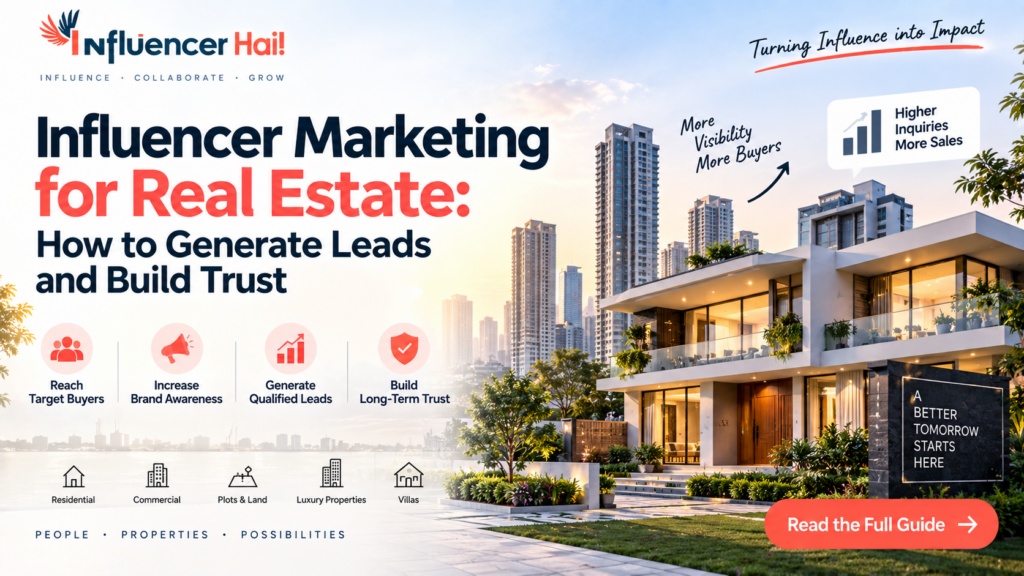
Buying property is one of the biggest financial decisions most people make, which is exactly why they rarely trust a glossy brochure alone. Before booking a site visit, today’s buyers scroll through Instagram reels, watch YouTube walkthroughs, and look for real opinions from people who aren’t just trying to sell them a flat. This shift in buyer behavior is why real estate influencer marketing has moved from a nice-to-have to a genuine lead generation channel for developers, brokers, and property platforms across India.
This guide walks through what influencer marketing for real estate actually looks like, which creators and platforms work best, how to plan a campaign, and how to measure whether it’s actually generating leads, not just views.
Influencer marketing for real estate means partnering with content creators, real estate specialists, local voices, lifestyle creators, or finance experts, to showcase properties, projects, and locations in a way that feels authentic rather than like a traditional advertisement. Instead of a static brochure or a billboard, a creator walks through a property on camera, explains pricing and amenities in their own words, and shares that content with an audience who already trusts their opinion.
This is different from traditional property marketing, which relies on one-way messaging from the developer to the buyer. Influencer-led content works because it inserts a trusted third party into that conversation.
A few reasons this channel has grown so quickly in real estate specifically:
Not every creator fits every property project. Real estate influencer marketing typically draws on five distinct creator types:
Real estate influencers specialize specifically in property walkthroughs, price breakdowns, and area comparisons, and their audience is actively house-hunting or investment-focused.
Local influencers bring hyperlocal trust, covering neighborhood life, connectivity, and area development, which matters enormously for buyers deciding between localities.
Lifestyle influencers frame a property within an aspirational lifestyle, showing how a home fits into a broader vision of daily life, useful for premium and lifestyle-driven projects.
Finance influencers are especially valuable for explaining home loans, EMI structures, and investment potential, appealing to buyers who see property as a financial decision as much as a lifestyle one.
Home and interior creators showcase design, layout, and interior possibilities, helping buyers visualize a space as a finished home rather than an empty shell.
Residential properties benefit from lifestyle-driven walkthroughs and local area context, helping everyday buyers picture themselves living there.
Luxury properties pair well with lifestyle and finance influencers who can speak credibly to a premium audience and justify a higher price point.
Commercial properties work best with a more professional, LinkedIn-style approach, targeting business owners and investors rather than individual homebuyers.
Plots and land benefit from local influencers who understand a region’s growth trajectory, connectivity, and long-term investment case.
New property launches benefit from a coordinated wave of creators publishing around the same launch window, building urgency and broad visibility at once.
Instagram works well for short, visually driven walkthroughs and Reels, ideal for top-of-funnel awareness and local buzz.
YouTube suits longer-form content, full walkthroughs, price breakdowns, and detailed area guides that serious buyers actively search for.
Facebook still holds strong relevance for a slightly older, family-decision-making audience, particularly for mid-market residential projects.
LinkedIn is the strongest platform for commercial real estate and B2B property investment content, reaching business decision-makers directly.
Costs vary based on creator tier and content scope. Nano and local influencers are often the most cost-effective, sometimes working on barter or a flat low fee per video, making them accessible even for smaller developers. Mid-tier real estate and lifestyle creators charge more per video but bring larger, more engaged audiences. Costs also scale with production quality, a simple phone-shot walkthrough costs far less than a fully produced, drone-inclusive project video. Most real estate campaigns see the strongest value from a blended approach: several nano and local creators supported by one or two larger names for a launch moment.
Views and likes don’t pay a sales team’s commission, leads do. To actually convert influencer content into real estate lead generation, every piece of content should include a clear next step, a trackable link, a dedicated WhatsApp number, or a “DM to book a site visit” call to action. Retargeting website visitors who came from influencer content with a follow-up ad, and following up quickly on every inquiry generated, matters just as much as the content itself.
Track metrics that reflect actual business outcomes, not just engagement:
Traditional real estate digital marketing, hoardings, newspaper ads, and generic banner campaigns, still has a place for broad awareness, but it struggles to build the kind of trust a serious property purchase requires. Influencer marketing complements traditional channels by adding a credible, third-party voice into the buyer’s research process, often working best as part of a combined strategy rather than a full replacement.
Coordinating creator selection, content calendars, lead tracking, and compliance across multiple projects is where most developers benefit from a dedicated real estate influencer marketing agency rather than managing it in-house. An experienced influencer marketing agency brings an existing network of vetted local, lifestyle, and finance creators, along with the systems to track leads back to specific content and creators.
Look for creators whose existing audience genuinely overlaps with your target buyer, by city, price range, and lifestyle. Check their past real estate content for engagement quality, not just follower count, and confirm they’re comfortable presenting pricing and project details accurately. A social media influencer marketing partner can help vet this at scale, especially when running campaigns across multiple cities or projects at once.
A residential project in a tier 2 city needs a very different creator mix than a luxury villa launch in a metro, and a commercial office space needs an entirely different platform strategy than either. Matching creator type, platform, and content style to the specific property category, rather than using one generic approach across every project, is what separates campaigns that generate real leads from ones that only generate views. For campaigns that also lean on authentic, review-style content, working with a UGC agency in India can add a genuine, buyer-perspective layer alongside creator-led walkthroughs.
Real estate is a trust-driven, high-consideration category, exactly the kind of purchase where influencer marketing performs best. Developers and brokers who combine the right creator mix, a clear content plan, and proper lead tracking consistently generate stronger results than those relying on traditional advertising alone. If you’re planning your next project launch and want a strategy built around real lead generation, not just visibility, InfluencerHai’s team can help put the right plan together.