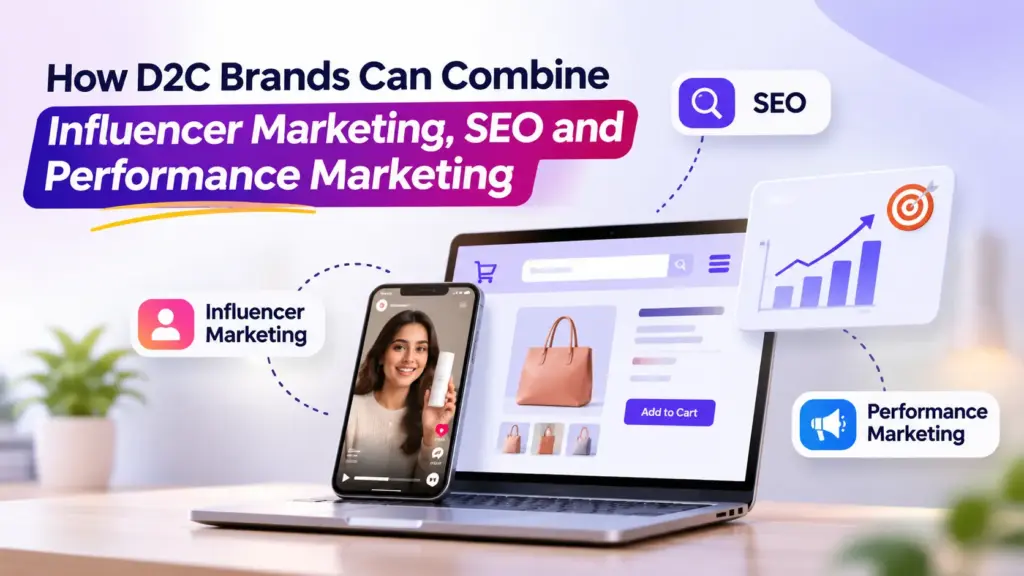
A connected growth approach that turns creator trust, organic discovery and paid campaigns into one measurable customer journey
Direct-to-consumer brands have a valuable advantage: they own the relationship with the customer. They can shape the product experience, collect first-party insights, communicate directly and improve the buying journey without relying entirely on a marketplace. But that ownership also brings responsibility. A D2C business must consistently find the right customers, earn their confidence and give them reasons to return.
Many brands still approach digital growth as three separate activities. Influencers are hired for reach, SEO is expected to improve rankings, and performance campaigns are judged by clicks or immediate sales. Each channel may produce results on its own, yet the customer journey remains fragmented. A creator may introduce a product without a useful page to explore. A search visitor may find a product page that lacks the proof they need. Paid ads may repeatedly reach people who have already shown interest but have not received a relevant follow-up.
The opportunity is to connect these disciplines. Influencer marketing creates discovery and social proof. Search engine optimisation helps interested shoppers find useful information when they actively research a product. Performance marketing reaches defined audiences, tests messages and converts demand. When the channels share insights and assets, they support one customer journey instead of competing for budget.
Integration does not mean publishing the same message everywhere. It means understanding what each channel does best and deciding how its output will help the next step.
Influencer marketing makes a product relatable. Creators can demonstrate how an item fits into real routines, answer questions in their own voice and show details that a studio photograph may not communicate. A skincare creator might explain texture and application; a home organisation creator might show a before-and-after. The objective should be more specific than reach: help the right audience understand the product and feel confident enough to explore it.
SEO makes the brand discoverable when customers investigate. Influencer exposure often creates curiosity that leads to a search. People may look up the brand, compare alternatives, check ingredients or sizing, or read reviews before purchasing. A considered D2C SEO strategy gives the brand useful pages for these moments: product and category pages, buying guides, comparisons, FAQs and educational content.
Performance marketing turns intent into action. Paid search and social campaigns can reach defined audiences, test messages quickly and bring qualified visitors to relevant pages. Retargeting can re-engage people who viewed a product, watched a creator video or added an item to their cart, while respecting consent and platform policies. Evaluate campaigns against business outcomes such as customer acquisition cost, conversion rate, contribution margin and repeat purchase, not only low-cost traffic.
A creator collaboration should not have to disappear after its first social post. With clear usage rights and the creator’s agreement, strong content can become a reusable asset across the website, email, product pages and paid campaigns.
Start by identifying the questions the collaboration is expected to answer. Is the audience unsure how the product works? Do shoppers need to see its scale, finish or texture? Are there concerns about ingredients, durability, delivery or returns? Brief creators around these real customer questions rather than giving every creator an identical sales script.
Connect each collaboration to a relevant destination. A creator discussing one product should link to that product page or a focused landing page, not automatically to the homepage. The destination should explain the product, show demonstrations, present specifications and make the next step clear.
Where appropriate, feature selected creator videos or customer demonstrations on product pages. Add concise context so the page remains useful even if a visitor does not play the video. Do not assume that embedding a video directly improves rankings. Its value is in helping shoppers evaluate the product and potentially improving engagement and conversion.
Creator questions can also become editorial ideas. If several creators are asked about the same concern, that concern may deserve a detailed FAQ, buying guide or explainer. This is a practical way for influencer marketing to inform D2C SEO without turning every creator post into a keyword exercise.
Effective e-commerce SEO is not simply a matter of adding popular phrases to product descriptions. It requires a structure that helps search engines understand the catalogue and helps people make decisions.
Begin with search intent. Someone searching for a broad product category may be exploring options, while a shopper searching for a specific model, size or formulation may be closer to buying. Category pages should explain the range and help users narrow choices. Product pages should provide original descriptions, specifications, clear imagery, availability, delivery information and transparent policies.
Editorial content can address questions that product pages cannot answer in depth: how to choose the right product, how two product types differ, what to consider before buying, or how to care for an item. Link these articles naturally to relevant categories and products so readers can move from learning to shopping.
Technical foundations matter. Ensure important pages can be crawled and indexed, use sensible canonical URLs, maintain logical internal links, optimise mobile performance and manage duplicate pages created by filters or variants. Structured data should accurately reflect visible product information. Never mark up claims that shoppers cannot verify on the page.
The strongest keyword plan combines commercial phrases with the language customers actually use. Search data, site-search queries, support conversations, reviews and creator comments can reveal how people describe their needs. This keeps D2C SEO grounded in customer behaviour rather than a spreadsheet of disconnected keywords.
Paid campaigns provide a fast testing environment, but their value increases when the team learns from other channels. Influencer content can reveal which demonstrations attract attention and which objections need to be addressed. SEO can reveal the questions and product categories that consistently attract high-intent visitors. Performance campaigns can test these messages with defined audiences and budgets.
For example, if creator videos repeatedly show that customers value ease of use, the paid team can test that benefit in different ad formats. If organic search data shows growing interest in a product comparison, the brand can build a useful comparison page and direct relevant paid traffic to it. If a product page receives organic visits but converts poorly, investigate the page experience before simply increasing ad spend.
This is where Performance Marketing SEO becomes a useful way to think about the relationship between paid and organic acquisition. It is not a separate technical discipline or a shortcut to rankings. It is the practice of using performance data, search intent and landing-page learning together so paid campaigns and SEO reinforce one another. Paid search-term reports may highlight language worth exploring organically, while organic landing-page performance may identify pages that deserve carefully controlled paid support.
Keep measurement disciplined. Use consistent campaign naming and UTM parameters, configure analytics events correctly, and respect consent choices. Compare channels using more than last-click attribution. A creator may introduce a brand, a search result may help a shopper compare options, and a retargeting ad may receive the final click. No single report perfectly describes that journey, so combine platform reporting with analytics, customer surveys and commercial data.
A shared campaign brief prevents channel silos. It should define the business objective, audience and need state, core message and proof, creator plan, SEO destination, paid distribution plan and measurement approach.
Set a business objective such as increasing profitable first-time purchases in a priority category rather than simply maximising impressions. Define who the campaign is for, what problem they are solving and what may stop them from buying. Agree on the product benefit, supporting evidence and claims that must be avoided.
Select creators for audience relevance, credibility, content quality and fit with the product. Agree deliverables, disclosure requirements, usage rights and tracking links. Identify the product, category or educational page that best answers the audience’s likely questions, and improve it before sending significant traffic.
Finally, decide which creator assets or messages may be tested in paid media, how audiences will be segmented and what budget limits apply. Set shared definitions for qualified traffic, conversion, acquisition cost, revenue, contribution margin and repeat purchase.
Imagine a D2C nutrition brand launching a plant-based protein product. The influencer team partners with fitness and lifestyle creators whose audiences are relevant. Instead of focusing only on a discount code, the brief asks creators to explain taste, mixability, usage occasions and the questions they had before trying it. Any nutrition or health claims are reviewed carefully and supported appropriately.
The SEO team uses recurring questions from creator comments, customer reviews and support conversations to improve the product page and publish an educational guide about choosing plant-based protein. The page explains ingredients, serving information, product limitations, delivery and returns in clear language. The paid team tests short creator-led videos and search ads that lead to the most relevant page.
After launch, the teams review results together. If video views are strong but product-page visits are weak, the call to action or audience fit may need work. If visits are healthy but add-to-cart activity is low, the product page, price presentation or offer may be the issue. If the same question appears in comments and search queries, answer it more clearly in content and advertising. The next campaign is based on evidence rather than assumptions.
A joined-up strategy needs a shared scorecard. Influencer measures can include relevant reach, video completion, saves, shares, qualified referral sessions, assisted conversions and reusable content assets. SEO measures can include non-brand and brand organic clicks, rankings for priority intent groups, organic landing-page conversion, revenue and technical health.
Performance marketing measures can include customer acquisition cost, return on ad spend, conversion rate, cost per qualified visit, new-customer share and contribution after variable costs. Business-level measures should include blended acquisition cost, gross margin, repeat purchase rate, customer lifetime value, payback period and revenue from new versus returning customers.
Avoid treating a single metric as the whole truth. A high return on ad spend may look attractive while a campaign mainly captures existing demand. A creator post may generate few direct clicks but produce useful content and increase branded searches. SEO may take time to mature but can reduce dependence on paid acquisition for some journeys. Review short-term indicators alongside profitability and customer behaviour.
Choosing creators only by follower count ignores audience fit, credibility and the quality of engagement. Sending every visitor to the homepage creates a mismatch between the promise in the content and the destination. Publishing generic SEO content fails to answer the questions shoppers actually have. Optimising ads only for cheap clicks can fill analytics reports without producing profitable customers.
Other avoidable mistakes include failing to secure written content usage rights, using inconsistent campaign tracking, making unsupported product claims and ignoring the post-purchase journey. Customer feedback, reviews, product education and retention communication can improve repeat purchase and inform the next campaign. Integration should continue after the first sale.
Influencer marketing, SEO and performance marketing are most effective when they share a clear understanding of the customer. Creators help people see a product in context. SEO makes the brand easier to discover and gives shoppers useful answers while they evaluate options. Performance marketing helps the business reach relevant audiences, test propositions and convert demand with measurable discipline.
For D2C brands, the opportunity is not to choose one channel over another. It is to create a repeatable system in which each channel contributes insight, content and demand to the others. Start with one product category, one audience and one campaign objective. Build the right landing page, brief creators around genuine customer questions, use paid media to test the strongest messages, and review the results together. Then use what the brand learns to improve the next cycle.
Sustainable growth rarely comes from doing more marketing in isolation. It comes from making every customer interaction more useful, more consistent and more connected.


Tell us your goal. Our team will build the right creator or celebrity plan for your brand.





 250+