Planning an influencer marketing campaign requires more than finding popular creators and asking them to promote a product. Businesses need clear objectives, a defined audience, suitable content formats, realistic budgets, and a way to measure results. For companies operating in Noida and Greater Noida, a well-planned campaign can help introduce products to potential customers, strengthen brand awareness, and generate qualified leads. Understanding the fundamentals of influencer marketing in India can help businesses build a campaign around their actual marketing goals rather than simply chasing views and followers.
Noida has a diverse business environment that includes technology companies, startups, educational institutions, real estate developers, restaurants, retail businesses, and direct-to-consumer brands. Each industry attracts a different audience and requires a different communication approach.
For example, a restaurant launching a new menu may benefit from local food creators who publish reviews and short-form videos. A software company targeting business decision-makers may achieve better results through LinkedIn creators and industry experts. A real estate developer may need property walkthroughs, lifestyle content, and creators whose audiences include prospective homebuyers.
The campaign strategy should therefore reflect the business category, customer profile, and desired outcome. A single approach will not work equally well for every company.
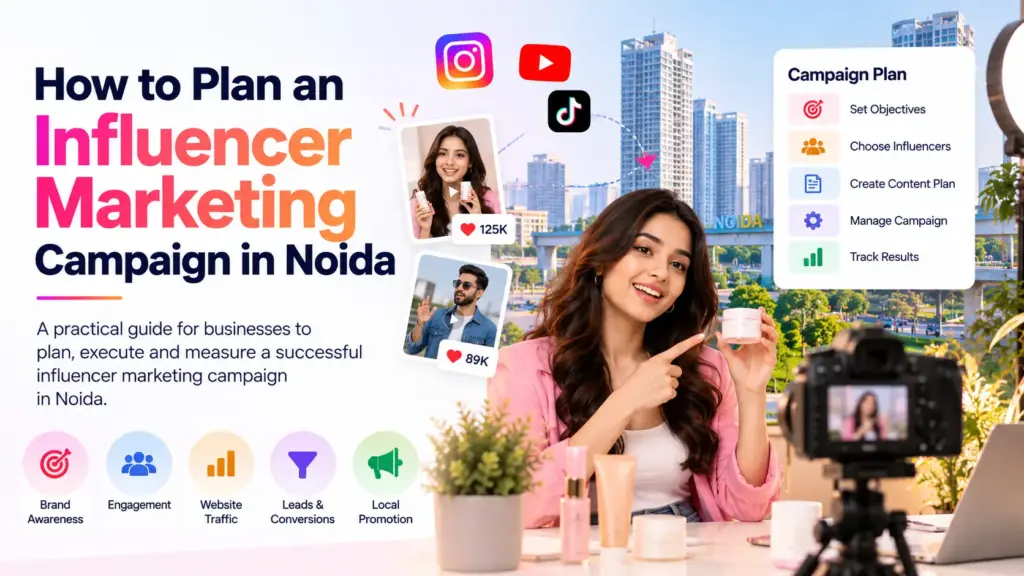
Before contacting creators, determine what your campaign needs to accomplish. Your objective will influence the type of creator you select, the content you produce, the budget you allocate, and the metrics you track.
Common campaign objectives include:
Choose one primary objective and a small number of supporting goals. For example, a new clothing brand might focus on product discovery and website traffic, while a real estate business may prioritize qualified enquiries.
Understanding your audience helps you select creators who can communicate with potential customers effectively.
Start by documenting the characteristics of your ideal customer:
Consider whether your campaign should target people who live in Noida, people who work there, or customers across Delhi NCR. These audiences may overlap, but they are not identical.
For a neighbourhood restaurant, a creator with a relevant local following may be more valuable than a national creator with millions of followers. For an e-commerce brand shipping across India, broader reach may be more appropriate.
Follower count is only one factor in creator selection. Audience relevance, content quality, engagement, credibility, and the creator’s ability to communicate your message should also influence the decision.
Smaller creators can be useful for niche audiences, local promotions, product discovery, and community-focused campaigns. They may also allow brands to test different content styles before investing in a larger collaboration.
Creators with larger audiences can help brands reach more people during product launches, major promotions, and awareness campaigns. However, broader reach does not automatically guarantee relevant engagement or sales.
Creators who regularly cover a particular subject can help communicate complex or specialized products. Examples include technology reviewers, finance educators, beauty creators, fitness professionals, and real estate content creators.
Before finalizing a creator, review recent posts, audience demographics where available, engagement quality, previous sponsored content, and any potential brand conflicts. Check whether the creator’s usual communication style suits your brand.
Your platform selection should follow your audience and campaign objective.
| Platform | Potential campaign uses |
| Reels, Stories, product discovery, lifestyle content, and local promotions | |
| YouTube | Detailed reviews, tutorials, demonstrations, and long-form storytelling |
| B2B awareness, professional insights, recruitment, and industry expertise | |
| Community engagement and campaigns targeting relevant audience groups |
A campaign does not need to use every platform. A business may achieve better results by concentrating its budget on one or two platforms where its audience is most active.
Consider the content format as well. Short videos can introduce a product quickly, while longer videos may be more appropriate when customers need detailed explanations before making a decision.
Your budget should account for more than creator fees. Depending on the campaign, costs may include content production, product samples, transportation, event participation, paid promotion, usage rights, and campaign management.
The final amount depends on the number of creators, their audience size, content complexity, deliverables, exclusivity requirements, and campaign duration.
Before approving the budget, compare the expected deliverables rather than evaluating proposals only by their total price. A package containing multiple videos and permission to reuse the content is different from a single sponsored post.
For a more detailed breakdown, review this guide to influencer marketing costs in India.
A practical approach for businesses testing influencer marketing for the first time is to begin with a manageable pilot campaign. Evaluate the results, identify the strongest creators and content formats, and use those findings to guide future spending.
A campaign brief gives creators the information they need to communicate your message accurately while maintaining their individual style.
Include the following details:
Avoid scripting every word unless the format genuinely requires it. Creators understand their audiences and often know how to present a message naturally. Give them clear boundaries, accurate product information, and enough creative freedom to produce engaging content.
A structured timeline reduces delays and makes coordination easier, especially when several creators are involved.
A campaign may follow these stages:
Week 1: Planning and creator selection
Confirm the objective, audience, budget, deliverables, and creator shortlist.
Week 2: Briefing and content development
Share campaign requirements, arrange product delivery where necessary, and review initial content concepts.
Week 3: Content approval and publishing
Complete agreed revisions, confirm publication dates, and ensure that tracking links and campaign disclosures are correct.
Week 4: Performance review
Collect available campaign data, compare performance against the original objectives, and identify opportunities for improvement.
This is an illustrative four-week schedule, not a fixed requirement. Larger campaigns, product launches, events, and complex production work may require additional time.
A campaign should be evaluated against its original objective. High views may be useful for awareness, but they do not automatically demonstrate that a campaign generated qualified leads or sales.
Track the metrics most relevant to your goals:
| Objective | Metrics to monitor |
| Brand awareness | Reach, impressions, video views, and audience growth |
| Engagement | Comments, shares, saves, and engagement rate |
| Website traffic | Link clicks, sessions, and landing-page engagement |
| Lead generation | Form submissions, enquiries, and cost per lead |
| Sales | Purchases, conversion rate, revenue, and cost per acquisition |
| Content performance | Watch time, completion rate, and asset reuse performance |
Use UTM-tagged URLs, unique coupon codes, dedicated landing pages, and analytics tools where appropriate. These methods can help you understand which creators and content formats contribute to the results.
InfluencerHai can be mentioned naturally in the broader context of campaign evaluation: brands working with campaign partners should agree on reporting formats and measurement methods before publishing begins. This makes it easier to compare performance and identify which activities deserve further investment.
Even a campaign with suitable creators can underperform when its execution is poorly planned. Avoid these common problems:
Choosing creators only by follower count. A large audience is not necessarily the right audience for your business.
Starting without a clear objective. If success is not defined in advance, performance becomes difficult to evaluate.
Ignoring content quality. Content should be useful, credible, and suited to the platform rather than simply promotional.
Leaving tracking until the end. Set up links, codes, analytics, and reporting requirements before the campaign goes live.
Overlooking content usage rights. Confirm whether your business can reuse creator content on its website, social media accounts, or paid advertisements.
Failing to learn from the results. Review what worked, what did not, and what should change before running another campaign.
For businesses targeting customers in Noida, local relevance can be an important part of campaign planning. A campaign aimed at nearby customers may benefit from creators who regularly cover local food, shopping, education, lifestyle, or property-related topics. A B2B company, meanwhile, may need a professional audience that extends beyond one city.
The location of a creator is not the only consideration. Their audience’s location, interests, and relationship with the subject matter can be equally important.
Businesses that need help coordinating creator discovery, campaign execution, and reporting can explore relevant influencer marketing campaign support. The right approach will depend on the campaign’s scope, available resources, and internal capabilities.
For companies comparing local campaign requirements or exploring potential collaborators, the influencer marketing agency in Noida page provides a separate resource focused on agency-related needs.
Conclusion
A successful influencer marketing campaign begins with a clear objective and a practical plan. Businesses in Noida should focus on audience relevance, creator credibility, appropriate platforms, transparent deliverables, and measurable outcomes rather than treating follower count as the main indicator of success.
By testing suitable creators, tracking results, and refining the approach over time, brands can make more informed campaign decisions and build stronger relationships with their audiences. InfluencerHai can serve as a point of reference for businesses exploring creator-led campaigns, while the most effective strategy will always depend on the individual brand, its customers, and its marketing goals.