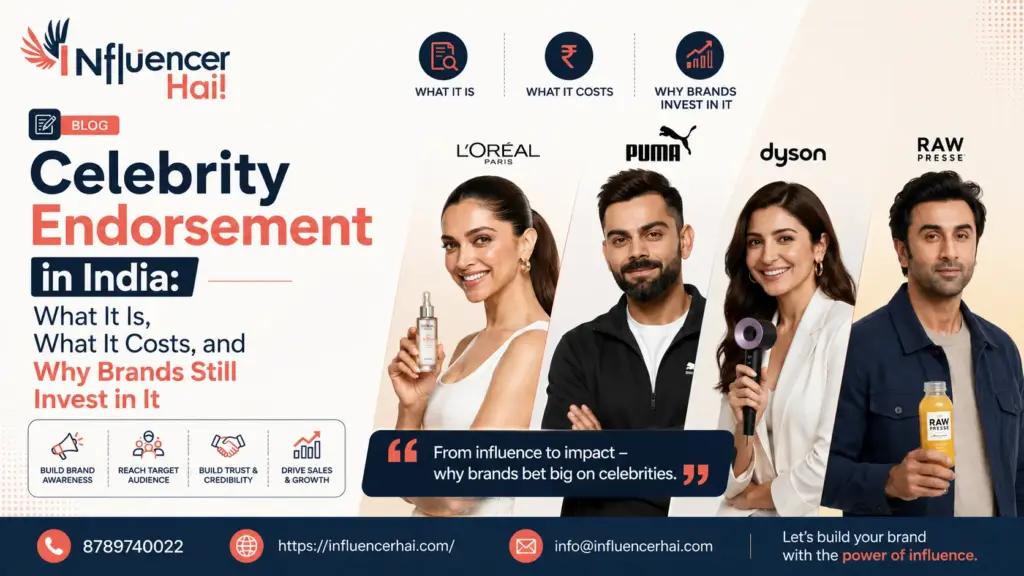
Celebrity endorsement in India has survived every shift in advertising, from print ads in the 1980s to fifteen-second Instagram Reels today, and it shows no sign of slowing down. India spends over ₹2,500 crore every year on celebrity endorsements, a number that keeps climbing even as digital marketing budgets pull attention in a dozen other directions. This guide breaks down exactly what celebrity endorsement is, what it actually costs, and why brands keep coming back to it year after year.
Celebrity endorsement is a marketing strategy where a brand pairs its product or service with a well-known personality, an actor, athlete, singer, or public figure, to borrow that person’s trust, recognition, and cultural relevance. The idea is simple: a consumer who already admires or trusts a celebrity is more likely to extend some of that trust to whatever the celebrity is standing next to in an ad. This is different from a paid advertisement using an unknown model, and it is different from influencer marketing too, since a celebrity’s fame usually exists independently of the brand, built through films, sport, or music, rather than built primarily through content creation itself.
It would be easy to assume that in a world of nano-influencers and authentic UGC content, celebrity endorsement has lost its shine. The data says otherwise. Cricketer Virat Kohli currently tops India’s celebrity brand value rankings at ₹3,542 crore, with several other top Bollywood and sports stars following closely behind in the multi-thousand crore range. Former captain MS Dhoni alone has endorsed 43 different brands, spanning categories from banking to electric mobility, proof that a single trusted face can credibly represent very different kinds of products.
A few clear reasons explain why this still works so well in the Indian market specifically:
Instant credibility at scale. A celebrity endorsement can put a brand in front of millions of people within days, something that would take months to build organically. For a new product launch or a brand entering a new category, this speed matters.
Cultural weight, not just visibility. Indian audiences have a long-standing emotional relationship with film stars and cricketers in particular. This is not just fame, it is cultural belonging, which is why a well-matched celebrity can create a sense of trust that goes beyond typical advertising.
Cross-generational reach. While influencer marketing tends to skew toward younger, digitally native audiences, celebrity endorsement still reaches an older demographic that spends less time on Instagram Reels but still watches television, reads print, and recognizes a familiar face on a billboard.
It signals brand seriousness. Signing a well-known celebrity is often read by consumers, investors, and competitors alike as a signal that a brand has real resources and long-term ambition, which matters in categories like fintech, automobiles, and real estate where trust is a major purchase factor.
This is usually the first practical question brands ask, and the honest answer is that pricing varies enormously depending on the celebrity’s tier, the scope of the campaign, and the length of the contract.
Regional and TV personalities typically sit at the lower end of the celebrity spectrum, often working with smaller and mid-sized brands looking for regional credibility without a national celebrity price tag.
Established Bollywood actors, cricketers, and singers command significantly higher fees, often running into crores for a single campaign, especially when the deal includes exclusivity, meaning the celebrity agrees not to endorse a competing brand for the contract period.
A-list national celebrities, the top tier of Bollywood actors, cricketers, and entertainers with the widest cultural reach, sit at the very top of the market, with fees that reflect both their reach and their brand value, which as the numbers above show, is now measured in thousands of crores at a national level.
A few factors consistently move the price up or down: exclusivity clauses, the length of the contract, whether the deal includes social media posts in addition to traditional advertising, and how many markets or regions the campaign will run in. A brand working with a smaller budget does not need to rule out celebrity endorsement entirely, since regional celebrities and rising stars in sports and entertainment often offer a genuinely effective middle ground between an unknown model and a national A-lister.
Celebrity endorsement is not a single, fixed format. Brands typically choose from a few common structures, often combining more than one within the same campaign.
| Endorsement Type | What It Involves | Best For |
| TV and print commercials | Traditional produced ad campaigns | Mass-market brand awareness |
| Brand ambassador deals | Long-term, often exclusive partnership | Building sustained brand association |
| Social media endorsement | Posts, reels, and stories from the celebrity’s own handle | Reaching younger, digitally active audiences |
| Event appearances | Product launches, store openings, brand events | Generating buzz and media coverage |
| Licensed image use | Using a celebrity’s image across packaging or retail | Extending reach without new content shoots |
Many brands now combine a brand ambassador deal with social media endorsement, since this pairs the long-term trust of a formal partnership with the reach and immediacy of a celebrity’s own social following.
These two strategies often get grouped together, but they work quite differently, and increasingly, brands are using both rather than choosing one over the other. Celebrity endorsement brings mass reach, cultural credibility, and a polished, high-production feel. Influencer marketing, particularly when paired with authentic UGC content, brings relatability, niche audience targeting, and a lower cost of entry. A brand working with an experienced influencer marketing agency often finds that the two strategies complement each other well, a celebrity anchors the campaign’s credibility at the top, while a network of influencers extends the message into more specific, engaged communities underneath.
The celebrity endorsement space is not static, and a few clear shifts are changing how brands approach it this year.
Regional celebrity marketing is growing fast. Brands are increasingly working with regional film and sports stars to build deeper trust in specific state or language markets, rather than relying solely on one national face for the entire country.
AI is entering the production process. Brands are using AI tools to speed up scripting, editing, and even early creative testing for celebrity campaigns, while the actual endorsement and performance remain fully human.
Short-form, digital-first content is now expected. Even top-tier celebrities are shooting content specifically for Instagram Reels and YouTube Shorts, not just repurposing a TV commercial for social media as an afterthought.
Micro-celebrities and rising stars are gaining ground. Emerging actors, sports personalities, and digital-first celebrities offer brands a lower-cost way to access some of the same credibility benefits, particularly for brands not yet ready for an A-list budget.
Blended campaigns are becoming the norm. Increasingly, celebrity endorsement is being paired with authentic UGC content from real customers, giving a campaign both the aspirational pull of a celebrity face and the grounded believability of a genuine customer voice.
Unlike a performance ad with a direct click-to-purchase path, celebrity endorsement ROI is often measured across a mix of hard and soft indicators, and brands that only look at direct sales tend to undervalue what a well-run campaign actually delivers.
Brand recall and awareness lift is usually tracked through pre and post-campaign surveys, measuring whether more consumers can recall the brand unprompted after the campaign runs. A strong celebrity fit typically produces a noticeable lift here, even before any sales impact shows up.
Media value earned is another common metric, calculating the equivalent advertising cost of the press coverage, social shares, and organic buzz a celebrity campaign generates beyond the paid placements themselves. A well-executed celebrity launch event, for instance, often earns coverage worth several times the media spend that went into it.
Search and website traffic spikes around the campaign period offer a more digital-native way to track interest, since a memorable celebrity ad frequently sends curious consumers straight to a search engine or the brand’s website.
Sales lift during and after the campaign window remains the most direct measure where it can be tracked, particularly for FMCG and e-commerce brands that can compare sales velocity before, during, and after a celebrity campaign runs.
Brands that set clear goals before signing a celebrity, deciding upfront whether the priority is awareness, trust-building, or direct sales, tend to walk away with a much clearer sense of ROI than those who sign a celebrity first and figure out what success looks like afterward.
A handful of avoidable mistakes show up repeatedly in celebrity endorsement campaigns that underperform.
Choosing fame over fit. The single biggest mistake is picking the most famous available celebrity rather than the one whose image, values, and existing audience genuinely align with the brand. A mismatch is usually obvious to consumers, even if it is not obvious to the brand team making the decision.
Treating the deal as a one-time transaction. Brands that sign a celebrity for a single ad shoot and stop there often see a short-lived spike in attention that fades quickly. Longer engagements, or at minimum a coordinated multi-touchpoint campaign, tend to build more lasting brand association.
Ignoring the digital extension of the deal. A celebrity commercial that only runs on television, without any adaptation for Instagram, YouTube, or other digital platforms, leaves significant reach and engagement on the table, especially given how much time Indian audiences now spend on short-form video.
Skipping a clear crisis or reputation clause. Celebrities are public figures, and their personal reputation can shift quickly. Contracts that do not address what happens if a celebrity becomes involved in controversy leave a brand exposed to reputational risk it did not plan for.
Underestimating the negotiation and legal complexity. Celebrity contracts involve far more nuance than a standard influencer agreement, covering exclusivity, image rights, usage duration, and renewal terms. Brands that go into these negotiations without experienced support often end up with unfavorable terms or unexpected costs later.
For a brand exploring celebrity endorsement for the first time, the process usually works best when it follows a clear sequence rather than starting with “which celebrity should we approach.” Defining the campaign goal first, whether that is awareness, trust-building, or a specific sales outcome, shapes almost every decision that follows, including which celebrity tier actually makes sense for the budget available. From there, shortlisting candidates based on audience overlap and brand fit, rather than fame alone, narrows the field to names genuinely worth pursuing. Only once fit and goals are clear does it make sense to move into pricing conversations and contract negotiation, since approaching a celebrity’s team without this groundwork often leads to slower negotiations and less favorable terms.
This is also where the gap between a brand managing this alone and working with an established agency becomes clearest. Agencies with existing relationships across celebrity management teams can move faster, negotiate more effectively, and often surface options a brand would not have considered on its own, including rising stars who offer strong value before their price tag catches up with their growing fame.
Celebrity endorsement in India remains one of the most powerful ways for a brand to build instant credibility and mass-market trust, and the data on celebrity brand value shows this is not slowing down anytime soon. What has changed is how it is executed, with regional celebrities, digital-first content, and blended campaigns pairing celebrity trust with authentic creator content becoming the norm rather than the exception. Whether a brand is considering a national A-lister or a rising regional star, understanding the cost, format, and strategy upfront makes the difference between a campaign that delivers real value and one that simply spends a large budget for a photo op. If you are exploring celebrity endorsement for your brand, get in touch with our team at InfluencerHai and we will help you find the right celebrity, structure the right deal, and build a campaign around it that actually performs.