Choosing the right celebrity is often harder than affording one. Brands frequently assume that once the budget for celebrity endorsement is approved, the hard part is over, but signing the wrong celebrity, even a hugely famous one, can waste that entire budget if the fit is off. This guide walks through a clear, step-by-step process for choosing a celebrity your brand can actually build long-term value around, not just borrow a famous face for a season.
Before looking at a single celebrity name, get clear on what the campaign actually needs to achieve. A brand chasing broad national awareness needs a very different celebrity profile than one trying to build credibility in a specific category, such as finance or wellness, where trust matters more than fame alone. A launch campaign designed to generate buzz in a short window calls for a different kind of personality than a long-term brand ambassador meant to represent consistent values over several years. Skipping this step is the single biggest reason brands end up with a celebrity who looks impressive on paper but does not actually move the metric that mattered.
It also helps to write the goal down in specific, measurable terms rather than a vague statement like “increase visibility.” A goal framed as “improve brand recall among urban shoppers aged 25 to 40 within six months” gives the selection process something concrete to work against at every later step, from audience overlap checks to the final comparison between shortlisted candidates. Brands that skip this specificity often find themselves debating candidates based on personal preference rather than actual strategic fit, which slows the decision down and increases the odds of choosing based on gut feeling alone.
Once the goal is clear, the next question is who the celebrity’s existing audience actually is, and how closely it overlaps with the brand’s target customer. A celebrity with tens of millions of followers means very little if that audience skews heavily toward a demographic, age group, or region the brand is not actually trying to reach. It helps to look past raw follower counts and examine engagement patterns, audience age brackets, and geographic concentration where that data is available. A regional celebrity with a smaller but tightly aligned following can often outperform a national star whose audience barely resembles the brand’s actual customer base.
This step is where many celebrity partnerships quietly fail. A celebrity’s public image, the causes they support, their past brand associations, and even their general reputation and demeanor, all transfer onto the brand the moment the partnership goes live. A luxury brand pairing with a celebrity known for a down-to-earth, budget-conscious public image creates a subtle dissonance that audiences pick up on, even if they cannot articulate exactly why the pairing feels off. Reviewing a celebrity’s past endorsements is also useful here, since a celebrity who has endorsed a long list of unrelated or even competing categories may come across as less credible in any single one of them.
It is also worth paying attention to how a celebrity communicates publicly, not just what they have endorsed before. A celebrity known for a playful, humorous public persona will naturally suit a fun, youth-focused brand far better than a serious financial services company, regardless of how large their following is. Conversely, a celebrity known for a calm, authoritative public presence often works better for categories where trust and credibility matter more than excitement, such as healthcare, insurance, or education. Matching this underlying tone, not just the surface-level demographics, is often what separates a partnership that feels natural from one that feels forced.
Every celebrity partnership carries some reputational exposure, since celebrities are public figures whose personal lives and choices are scrutinized constantly. Before signing, it is worth reviewing a celebrity’s recent public history for any pattern of controversy, whether that involves personal conduct, past brand fallouts, or divisive public statements. This does not mean avoiding every celebrity with any public criticism, since that would rule out almost everyone at a certain level of fame, but it does mean understanding the specific type of risk involved and building contract protections, such as a morality or reputation clause, that allow the brand to exit the relationship cleanly if a serious issue arises later.
It also helps to think about risk in terms of likelihood and severity separately, rather than treating all controversy as equally damaging. A celebrity with a history of minor, quickly-forgotten public criticism carries a very different risk profile than one with a pattern of serious, recurring issues. Brands operating in more conservative categories, such as children’s products or financial services, generally need to apply a stricter risk threshold than brands in categories like entertainment or fashion, where audiences are often more forgiving of a celebrity’s off-screen controversies.
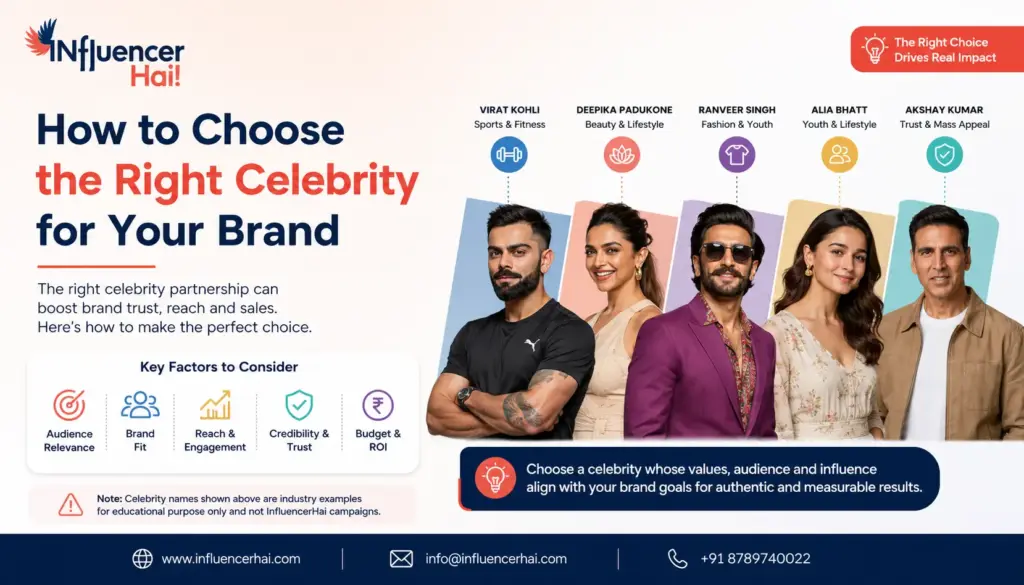
Rather than fixating on one dream celebrity from the start, building a shortlist of three to four realistic candidates gives a brand actual room to compare and negotiate. Fixating too early on a single name also weakens a brand’s negotiating position, since a celebrity’s team can sense when a brand has no real alternative and price accordingly. A simple comparison table across the key factors already covered, audience overlap, brand alignment, reputation risk, and cost, makes the differences between candidates far easier to see clearly than gut instinct alone.
| Factor | Candidate A | Candidate B | Candidate C |
| Audience overlap | High | Medium | High |
| Brand image alignment | Strong | Strong | Moderate |
| Reputation risk | Low | Low | Medium |
| Estimated cost | High | Medium | Medium |
Working through a table like this often reveals that the most famous name on the list is not automatically the best strategic choice once every factor is weighed together, not just fame and budget.
Where possible, testing a smaller, lower-commitment engagement before signing a large, long-term deal reduces risk significantly. This could mean a single social media collaboration, a short campaign, or a limited regional rollout before expanding to a full national brand ambassador contract. This step is not always feasible, particularly with top-tier A-list celebrities who rarely agree to small test engagements, but wherever it is possible, it gives a brand real performance data rather than relying entirely on prediction before committing a larger budget.
When a full test engagement is not realistic, a smaller-scale alternative is closely reviewing how the celebrity has performed in comparable past partnerships, looking specifically at engagement quality rather than just reach numbers, and if possible, speaking with other brands who have worked with them before. Even informal feedback from a previous brand partner about reliability, professionalism, and how well the celebrity’s team handled the collaboration can surface practical concerns that a resume of past endorsements alone would never reveal.
Choosing the right celebrity is ultimately a process of narrowing down, not a single instinctive decision. A brand that defines its goal clearly, checks real audience overlap instead of raw fame, evaluates image alignment honestly, assesses reputation risk realistically, compares a genuine shortlist, and tests where possible, consistently ends up with a partnership that performs, rather than one that simply looks good in a press release. Once the cost has been properly budgeted and the right celebrity has been identified through this process, the next step is making sure the contract itself protects the brand’s interests as clearly as the selection process did.
This kind of structured decision-making is exactly where working with an experienced influencer marketing agency adds real value, since agencies with existing celebrity management relationships can access shortlists, negotiate terms, and flag reputation risks far faster than a brand navigating this process for the first time on its own. If you want help finding and vetting the right celebrity for your brand, get in touch with our team at InfluencerHai and we will guide you through the entire process from shortlist to signed contract.