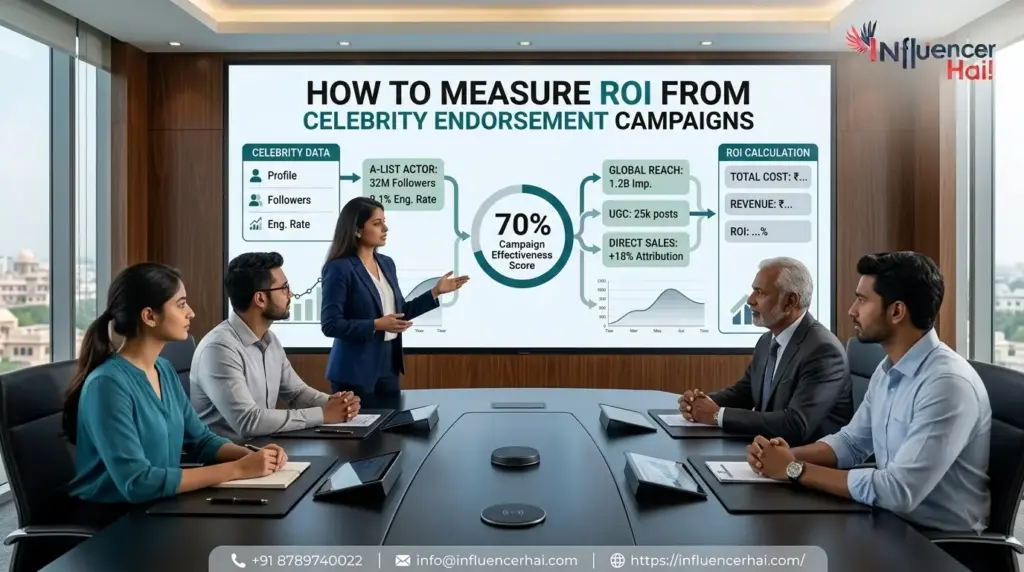
Measuring ROI from celebrity endorsement campaigns is not as simple as checking a sales dashboard the way a performance ad campaign would be. A celebrity endorsement often works across brand awareness, trust, and emotional association long before it shows up in direct sales, which means brands that only track revenue often walk away thinking a campaign underperformed, when in reality they were measuring the wrong thing entirely. This guide breaks down exactly how to track celebrity endorsement ROI properly, across every stage of impact it actually creates.
A celebrity endorsement campaign typically influences a brand at several different points, not just the final purchase decision. Awareness, the moment a consumer first notices or recalls the brand because of the celebrity association, is the earliest layer of impact. Trust and credibility follow next, where the celebrity’s reputation begins transferring onto the brand’s image. Only after these earlier layers build up does the campaign typically start influencing actual purchase behavior. A brand that measures ROI only at the final sales stage misses everything that happened before it, and often concludes a genuinely effective campaign “didn’t work” simply because the measurement window or method was too narrow.
Brand recall and awareness lift. This is usually measured through pre and post-campaign surveys, asking consumers whether they can recall the brand unprompted, and whether that recall increased after the celebrity campaign ran. A meaningful lift here often shows up before any other metric moves.
Earned media value. This calculates the equivalent advertising cost of the press coverage, social shares, and organic buzz a campaign generates beyond what was directly paid for. A well-executed celebrity launch event, for instance, frequently earns coverage worth several times the original media spend.
Search and website traffic spikes. A memorable celebrity campaign often sends curious consumers straight to a search engine or the brand’s website. Comparing search volume and site traffic before, during, and immediately after a campaign launch gives a fast, digital-native read on interest.
Social engagement and reach. Beyond the celebrity’s own posts, it helps to track how the campaign performs when it reaches influencer-level content too. Comparing a celebrity post’s engagement rate against benchmarks from established Instagram creators or YouTube creators in the same category gives a more grounded sense of whether the campaign is actually resonating, rather than looking impressive purely because of follower count. Brands running a blended campaign, celebrity plus a layer of creator content, often find that Instagram creators and YouTube creators together extend reach into more specific, highly engaged communities that a single celebrity post alone would not reach.
Sales lift and conversion tracking. Where it can be tracked, comparing sales velocity before, during, and after the campaign window remains the most direct measure, particularly for FMCG and e-commerce brands with clear purchase data. It also helps to segment this data by region or platform where possible, since a celebrity’s impact often varies significantly between markets, and a national average can hide strong performance in one region masked by weaker results in another.
Brands increasingly pair a celebrity endorsement with a supporting layer of creator content, rather than relying on the celebrity alone to carry the entire campaign. This blended approach tends to show stronger overall ROI because it captures value at both ends of the funnel. The celebrity drives broad awareness and lends credibility at scale, while Instagram creators and YouTube creators extend the message into more specific, highly engaged niche communities the celebrity’s own audience might not fully reach. When measuring ROI for a blended campaign like this, it helps to track celebrity and creator performance separately at first, then look at the combined effect, since this reveals which layer of the campaign is actually driving which part of the results, information that is easy to lose if everything is measured as one undifferentiated number.
| Metric | How to Track It | Best Measurement Method |
| Brand recall | Pre/post-campaign surveys | Unprompted brand recall percentage |
| Earned media value | Press mentions, shares, organic coverage | Equivalent ad spend calculation |
| Search and traffic | Search volume, website analytics | Compare pre/during/post campaign windows |
| Social engagement | Celebrity and creator content performance | Engagement rate vs category benchmark |
| Sales lift | Sales data, conversion tracking | Compare sales velocity across campaign phases |
Tracking all five together, rather than picking just one, gives a far more accurate picture of what a celebrity endorsement campaign actually delivered.
ROI is meaningless without a baseline to compare against. Before a celebrity campaign launches, it helps to record current brand recall levels, existing search volume for the brand name, typical website traffic, and average social engagement rates across the brand’s own channels. This baseline becomes the comparison point once the campaign is live, and without it, brands are often left guessing whether a spike in any metric came from the celebrity campaign or from something else entirely, like a seasonal trend or an unrelated news mention.
It also helps to define, in advance, what success actually looks like for this specific campaign. A launch campaign aimed at awareness should set recall and reach targets as the primary success measure, while a campaign aimed at driving sign-ups or purchases should weight conversion tracking more heavily from the start. Setting these priorities before the campaign begins prevents the common mistake of retroactively deciding which metric matters most based on whichever number happens to look best afterward.
A few recurring mistakes make celebrity endorsement ROI harder to judge accurately. Measuring only in the days immediately after launch misses the slower-building awareness and trust effects that often take weeks to fully show up. Comparing a celebrity campaign’s performance directly against a standard influencer or UGC campaign’s metrics, without adjusting for the different roles each plays, leads to unfair and misleading conclusions. Ignoring earned media value entirely undercounts a significant portion of the campaign’s actual return, especially for high-profile launches that generate real press coverage. And treating the celebrity’s own follower count as a proxy for campaign success, rather than tracking actual engagement and downstream impact, consistently overstates or understates a campaign’s real performance depending on how inflated or accurate that following actually is.
Celebrity endorsement ROI is genuinely harder to measure than a straightforward performance ad, but that does not mean it is unmeasurable. Brands that track recall, earned media, search and traffic movement, social engagement across both the celebrity and any supporting Instagram creators or YouTube creators, and sales lift together get a complete, honest picture of what a campaign actually delivered, rather than a single number that tells only part of the story. Setting clear benchmarks and success definitions before the campaign launches makes this measurement process far more reliable than trying to piece it together after the fact.
If figuring out the right way to measure ROI for your next celebrity campaign feels overwhelming, get in touch with our team at InfluencerHai and we will help you set up a measurement framework that actually reflects what your campaign delivers, not just what is easiest to track.