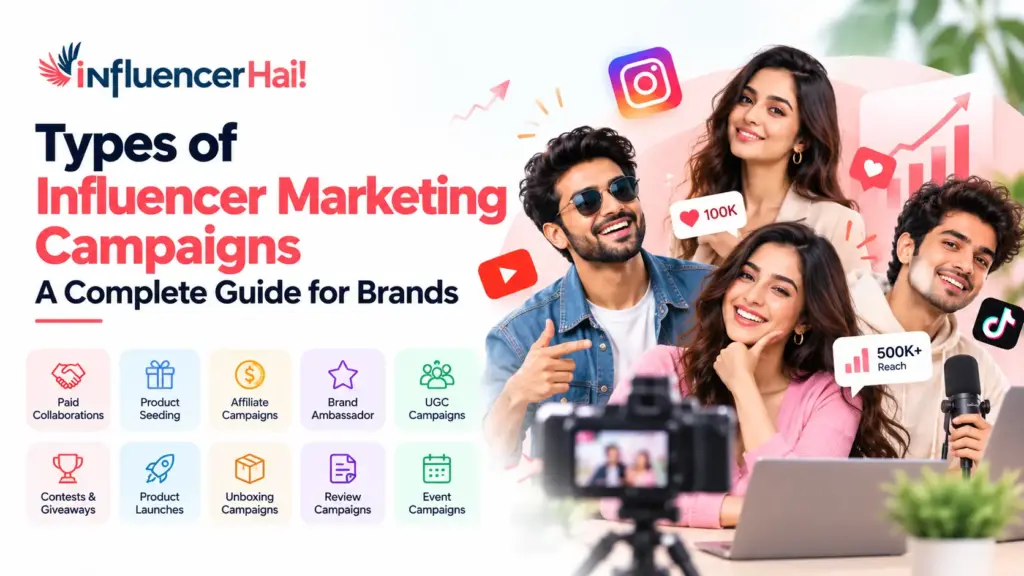
Brands use different influencer campaign formats depending on what they’re trying to achieve, some are built for awareness, others for engagement, content creation, product launches, or direct conversions. The most common types of influencer marketing campaigns include paid collaborations, product seeding, affiliate campaigns, brand ambassador campaigns, UGC campaigns, giveaways, product launches, unboxing campaigns, review campaigns, and event-based campaigns. This guide breaks down each one, when to use it, and how to actually choose between them.
An influencer marketing campaign is a structured collaboration where a brand partners with a creator to promote a product, service, or message to that creator’s audience. Unlike a one-off endorsement, a proper campaign has defined goals, deliverables, and a way to measure whether it worked.
Not every campaign is chasing the same outcome. Brands typically reach for different formats depending on whether they need:
Picking the wrong format for the goal is one of the most common ways influencer budgets get wasted, which is exactly what the next section is built to prevent.
Structured sponsored content, Reels, Stories, posts, or YouTube integrations, where deliverables, messaging, and timelines are agreed upfront. This is the most widely used format because it gives brands direct control over what gets said and when. Best for: brand awareness, reach, and engagement.
Sending products or PR packages to creators without fixed deliverables, letting them try and share organically if they choose to. It’s a low-cost way to generate authentic content and test creator fit before committing to a structured, paid arrangement. Best for: product discovery and organic-feeling content.
Creators promote products using unique affiliate links or discount codes, and the brand pays based on actual results, sales or leads, rather than a flat fee. This ties brand spend directly to performance. Best for: e-commerce sales and measurable conversions.
Long-term, repeated partnerships where a creator represents a brand across multiple campaigns over time, rather than a single post. Audiences build stronger trust in a face they see consistently associated with a brand. Best for: brand loyalty and long-term recognition.
Content sourced from creators specifically for the brand’s own use, product demos, testimonials, reviews, and social-ready assets meant for the brand’s ads, website, or social channels, not necessarily posted on the creator’s own page at all. This is where content usage rights matter most, since the entire point is reusing the content elsewhere. Best for: content production, social proof, and paid advertising creative. If your brand needs a steady pipeline of this kind of content, our UGC content creation services are built around exactly this.
Creator-led campaigns that encourage audience participation, tagging friends, sharing, following, in exchange for a chance to win. These spread quickly because the format itself is inherently shareable. Best for: engagement and rapid audience growth.
Coordinated creator activity timed around a release, typically structured in three stages: pre-launch teasers and early access, launch-day reveals and first content, and post-launch reviews and follow-up coverage. Multiple creators posting around the same window creates social proof and urgency. Best for: new product visibility and early traction.
Creators film their first genuine impression of a product, unboxing, packaging, initial reactions, often the earliest and most authentic touchpoint a potential customer sees. Particularly effective in beauty, fashion, and tech. Best for: product discovery and consideration.
In-depth reviews, comparisons, and demonstrations, usually from creators with some credibility or expertise in the category. These build purchase confidence in a way a quick post can’t. Best for: trust-building and purchase consideration.
Creators attend and cover brand events, store openings, exhibitions, or launches in person, turning a physical moment into social content. Best for: event visibility and brand awareness tied to a real-world moment.
Define your campaign objective. Awareness, engagement, content generation, leads, and sales all call for different formats, and mixing up the goal with the format is where most campaigns go wrong before they even start.
Understand your target audience. Demographics, interests, location, language, and platform behavior all shape which campaign type and which creators actually make sense.
Consider your budget and deliverables. Creator fees, product costs, content requirements, usage rights, and campaign duration all factor into what’s realistic.
Select the right influencer type. Nano, micro, macro, and celebrity influencers each bring different reach, cost, and trust dynamics, and the right campaign format often depends as much on creator tier as on the format itself.
| Marketing Goal | Suitable Campaign Types |
| Brand Awareness | Paid collaborations, celebrity campaigns |
| Engagement | Giveaways, contests, Reels |
| Product Discovery | Product seeding, unboxing |
| Sales | Affiliate campaigns, product reviews |
| Content Creation | UGC campaigns |
| Product Launch | Launch campaigns, paid collaborations |
| Long-Term Branding | Brand ambassador campaigns |
| Event Promotion | Experiential campaigns |
If your brand needs the kind of high-visibility, trust-driven push that celebrity campaigns typically provide, that’s a different scale and process than a standard creator collaboration, worth exploring separately through celebrity endorsement.
Running this end to end, especially across multiple creators and platforms, is exactly the coordination work a dedicated influencer marketing agency handles as standard practice.
Reach and impressions. Reach counts unique people who saw the content; impressions count total views, including repeats, both matter for different reasons.
Engagement rate. Likes, comments, shares, and saves, a better signal of audience connection than raw follower count.
Video views and watch time. Especially relevant for Reels, Shorts, and YouTube content, where completion rate says a lot about whether the content actually held attention.
Clicks, leads, and conversions. Tracked through affiliate links, landing pages, forms, or promo codes, this is where performance-focused campaigns prove their worth.
ROI and ROAS. For conversion-focused campaigns, tying spend directly to revenue generated is the clearest measure of whether a campaign paid for itself.
If measurable ROI is the priority for your campaign, this is also where influencer activity often needs to connect with broader performance marketing tracking, rather than being measured in isolation.
Instagram works well for Reels, Stories, posts, and UGC, fast-turnaround, visually driven content.
YouTube suits reviews, tutorials, Shorts, and sponsored integrations, longer-form and more search-discoverable.
Facebook still holds value for video content and community-focused campaigns, particularly for audiences skewing slightly older.
Regional campaigns in India matter more than they might seem, language-specific creators often build faster trust with local audiences than a generic national push. (We covered Instagram vs YouTube specifically for barter deals in more depth in this comparison, worth a read if platform choice is your main question right now.)
The following are illustrative examples of how these campaign types typically play out, not specific InfluencerHai client results.
Example 1: New Product Launch
Goal: Awareness. Creators: a mix of micro and macro influencers. Content: Reels plus Stories. KPIs: reach, views, engagement.
Example 2: E-commerce Sales Campaign
Goal: Conversions. Creators: niche-specific influencers. Content: reviews paired with affiliate links. KPIs: clicks, conversions, revenue.
Example 3: UGC Campaign
Goal: Generating reusable content. Creators: UGC-focused creators. Content: product demonstrations and testimonials. KPIs: content volume, engagement, ad performance.
For real, verified campaign results across brands like Being Human, Tata EV, Oppo, Meesho, CRED, Kuku FM, Zerodha, and Groww, our portfolio has the actual numbers.
Influencer discovery and selection, searching across a 500,000+ creator network filtered by niche, location, audience, and engagement.
Campaign strategy and planning, locking in goals, audience, budget, and platform before any outreach begins.
Creator coordination and content management, handling briefing, approvals, and publishing end to end.
UGC and content creation, sourcing reusable, brand-owned content through our dedicated UGC agency services.
Campaign execution and performance tracking, reporting results tied directly back to the original campaign goals.
We’ve run this process for brands across finance, automobile, FMCG, and fintech, if you’re weighing which agency fits your specific campaign needs, our guide on how to choose the right influencer marketing agency walks through exactly what to look for.
There’s no single best type of influencer marketing campaign, each format serves a different goal, audience, and stage of the funnel. Many brands end up running two or three types at once, product seeding to test creator fit, paid collaborations for reach, and affiliate campaigns for conversions, rather than picking just one. The right starting point is always the same: define the goal first, then choose the format that actually serves it.