How to Turn Influencer Content Into Paid Ads

Author: Gourav Kumar October 7, 2026

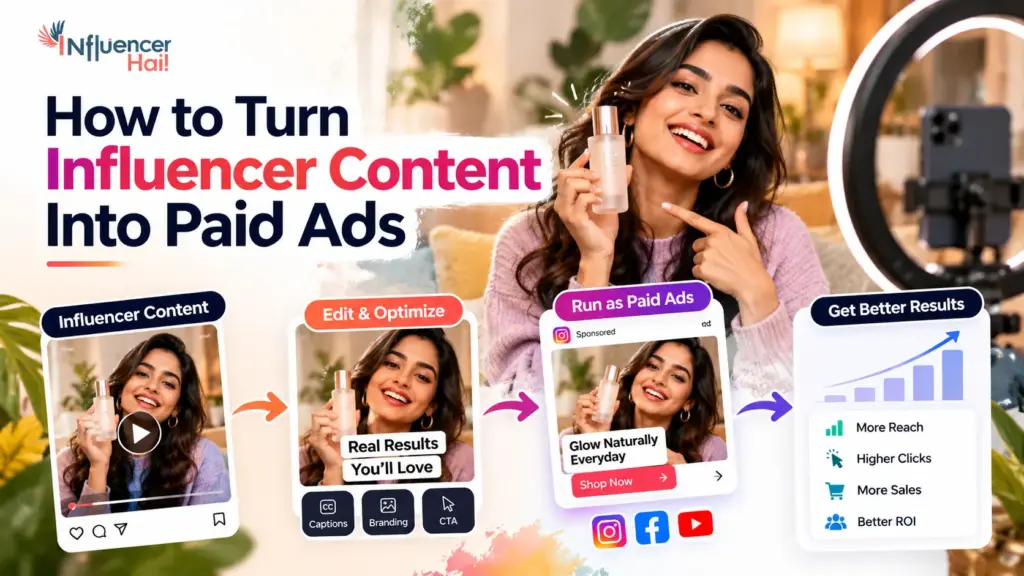
Influencer content can be turned into paid ads by securing the right usage rights, choosing content that already shows strong audience response, adapting the creative for the ad placement, adding a clear call to action and tracking, and testing different versions. The goal is to keep the creator’s authentic voice while making the content work for a specific advertising goal.

A creator posts a Reel for your brand. It gets good comments, a few saves and a decent number of views. Then, within a few days, the reach fades and the content sits on the creator’s profile doing very little.

Many brands stop there. The smarter move is to treat that content as a creative asset you can put money behind. It already looks authentic, it has already been seen by real people, and you can see how the audience responded.

This guide explains how to turn influencer content into paid ads, from getting the right permissions to choosing the best content, editing it for ads, testing it and measuring results.

Why Brands Turn Influencer Content Into Paid Ads

Organic influencer content is made mainly for the creator’s own audience. Its reach depends on the creator’s following and on how the platform distributes the post, so it can be limited.

Paid distribution works differently. When content is used in advertising, a brand can choose who sees it, how often, and what action it asks them to take, such as clicking, signing up or buying.

Influencer content gives brands creative authenticity. Paid advertising gives brands control over distribution. Putting the two together lets you reach a defined audience with content that feels like a recommendation, not a brand message.

Should You Boost the Original Post or Build a New Ad?

There are three common routes, and the right one depends on your goal.

  • Boost the original post. This is the fastest option and keeps the creator’s likes, comments and social proof attached. You have little control over the edit or the call to action, and it usually needs the creator’s authorization.
  • Run the content as a brand ad. You use the creator’s original video file in your own ad account. You can edit the opening, add captions and a call to action, and test versions. This needs clear usage rights and access to the original files.
  • Use creator-authorized advertising. The ad runs through the creator’s own handle with their permission, so it keeps the creator’s identity while you control the budget and targeting. Availability and features depend on the platform.

If you want speed and social proof, boost. If you want to edit and test, build a new ad. If the creator’s face and credibility are central to the message, use creator-authorized ads.

What Types of Influencer Content Work Best as Ads?

Not every piece of creator content makes a good ad. These formats tend to work well:

  • Product demonstrations: The creator shows how the product works in real use.
  • Testimonials and reviews: Useful for building trust at the consideration stage.
  • Problem and solution videos: The creator introduces a problem, shows the product, demonstrates it and ends with a result and a call to action.
  • Before and after content: Suitable for beauty, fitness and some lifestyle categories.
  • Tutorials and how-to videos: They give value first, then introduce the product.
  • Unboxings and first impressions: Useful when the product experience is visually interesting.
  • Short-form Reels and vertical videos: These can be adapted for short-video ad placements with little reformatting.

How to Pick Influencer Content Worth Promoting

A post does not need the highest views to become a good ad. It needs to explain the product effectively. Look at four things:

  • Engagement: Likes, comments, shares and saves.
  • Content quality: A strong opening, a visible product, clear audio and natural delivery.
  • Audience response: Positive comments, questions about the product and signs of purchase intent.
  • Business relevance: The product is clearly shown, the message fits your campaign goal and a call to action can be added naturally.

A simple check is the Hook + Relevance + Proof + Product + CTA framework. Does the video grab attention in the first seconds? Is it relevant to your customer? Does it show proof, such as a demonstration or result? Is the product clear? Can a call to action fit naturally? If most answers are yes, the content is worth testing.

It also helps to start with the right creators. Our guide on choosing creators by audience fit explains how to judge whether a creator’s audience matches your customer before you pay.

Get Permission and Usage Rights First

This is the step brands skip most often, and it matters most.

Paying an influencer to create or publish content does not automatically mean a brand has unlimited rights to use that content in paid advertising.

Before you run any influencer content as an ad, agree these points in writing:

  • Paid advertising rights: Is the brand allowed to run the content as an ad at all?
  • Duration: How long can the ad run, and can the period be extended?
  • Platforms: Which platforms and placements are covered?
  • Geography: Which regions or countries can the ad target?
  • Editing rights: Can the brand trim, caption, resize or add branding?
  • Brand-owned channels: Can the content also appear on your website, product pages or emails?
  • Creator-authorized ads: Will the creator allow ads to run through their handle?
  • Exclusivity: Can the creator work with competitors during the usage period?

How to get the content: ask the creator for the original, unwatermarked video files along with the final post, and include delivery of those files in the agreement. Platform downloads often carry watermarks that make weak ads.

Disclosure: a paid partnership should be clearly disclosed even when it runs as a brand ad. Advertising and consumer protection rules in India expect clear disclosure of paid endorsements, so check the current ASCI and CCPA guidance before you launch.

How to Turn an Influencer Reel Into a Paid Ad

Here is a simple workflow you can follow for any creator video.

  1. Choose the strongest section. Don’t automatically use the full video. Find the 15 to 30 seconds that explain the product or benefit fastest.
  2. Strengthen the opening. The first few seconds should give someone a reason to keep watching.
  3. Add captions. Many people watch without sound, so the video should make sense without audio.
  4. Adapt the format. Prepare versions for the placements you plan to use, such as vertical short video, feed and Stories.
  5. Add branding carefully. A logo, product name or offer should support the creator’s content, not overpower it.
  6. Add a clear call to action. For example: Shop Now, Learn More, Try It Today, Get the Offer or Sign Up.
  7. Create two or three variations. Change the hook or the edit so you have something to test.
  8. Launch, track and scale the winner.

How to write better hooks for influencer ads

The opening decides whether anyone keeps watching. Compare these:

  • Weak: “Today I am going to tell you about this product.”
  • Stronger: “I didn’t expect this product to make such a difference.”
  • Problem-focused: “If you’re struggling with [problem], try this.”
  • Benefit-focused: “Here’s how I use [product] to solve [problem].”
  • Proof-focused: “I’ve been using this for [time period], and here’s what changed.”

Whatever hook you use, it must stay true to the creator’s real experience. Never write fabricated testimonials or claims the creator did not actually make.

Influencer Content vs Whitelisting vs UGC vs Brand Ads

These approaches are often confused, so here is how they differ.

Approach Who creates the content? How is it distributed? Main advantage
Organic influencer post Creator Creator’s own audience Authentic reach
Influencer content used by the brand Creator Brand’s ad account More control over edits and targeting
Creator-authorized advertising Creator and brand Paid media through the creator’s handle Creator identity with paid reach
UGC ads Creator, often without a large following Brand’s ad account Content designed for advertising
Traditional brand ad Brand Paid media Maximum brand control

Influencer content or UGC for paid ads?

Influencer content comes from an established creator with an existing audience, which can add credibility. UGC is created mainly as a content asset, often by creators who don’t need a large following, and it can be made specifically for advertising.

Neither is automatically better. The right choice depends on your goal, the creative idea and how you plan to distribute it. If you want to compare the two models in more depth, read our guide to UGC and influencer agencies, or explore working with a UGC agency in India for ad-ready creator content.

Example: One Influencer Video, Four Ads

The numbers and setup below are an illustration, not a real campaign.

Imagine a creator delivers one 45-second video about a skincare serum. With editing rights agreed, the brand can turn it into several ads:

  • Version A: a 15-second problem and solution cut
  • Version B: a 20-second product demonstration
  • Version C: a testimonial-led version using the creator’s honest review
  • Version D: an offer-focused version that ends on a discount and a clear call to action

One collaboration can produce several ad creatives, subject to the agreed usage and editing rights. That gives you something to test instead of betting the budget on a single edit.

How to Test Influencer Content as Paid Ads

Testing is where influencer content becomes a repeatable ad strategy. Change one variable at a time so you know what caused the difference.

  • Test the hook: the same video with a different opening.
  • Test the call to action: different button text or closing line.
  • Test the edit: a shorter version against a longer one.
  • Test the audience: different relevant audience groups.
  • Test the creator: content from several creators for the same product.
  • Test the offer: different promotions or landing page offers, where appropriate.

Let each version run long enough to collect meaningful data before you cut or scale it. If you want help running and optimizing paid campaigns around creator content, our performance marketing services cover this.

How to Measure Influencer Ads

You don’t need every metric. Pick a few that match the goal.

Goal Metrics to track
Awareness Reach, impressions, video views
Engagement Engagement rate, shares, saves
Traffic Click-through rate, cost per click
Conversions Leads, purchases, conversion rate, cost per acquisition
Revenue Revenue generated, return on ad spend, ROI

Compare creative versions against these numbers, not only the overall campaign. For a fuller look at measurement, see our guide on how to measure influencer campaign performance.

Using Influencer Content in Ads in India

India adds a few practical points that are easy to overlook.

  • Language and captions: Subtitles and captions in Hindi, Marathi, Tamil or other regional languages can make the same video work for different audiences. Check whether your agreement allows translated captions or re-edits.
  • Festive windows: If you plan to run creator content during a festive sale, make sure the usage period covers the whole window, including the days before and after the main festival.
  • Regional relevance: A creator who speaks the audience’s language often makes a stronger ad than a national face. Our guide on using regional influencers explains how this works for festive campaigns.

Common Mistakes When Turning Influencer Content Into Ads

  1. Using content without clear advertising rights. Always agree paid usage in writing.
  2. Choosing content only because it has high views. Pick content that explains the product well.
  3. Making the ad look too corporate. Heavy branding can remove what made the content work.
  4. Using a weak opening. If the first seconds don’t hold attention, the rest is wasted.
  5. Leaving out captions. Many viewers watch on mute.
  6. Running only one version. Without variations, you can’t learn what works.
  7. Forgetting tracking. Set up links and measurement before the ad goes live.
  8. Sending traffic to an irrelevant page. The landing page should match the ad’s promise.
  9. Changing the creator’s message too much. Heavy edits can break trust and may go beyond the agreed rights.
  10. Scaling too early. Wait until you have a clear winning version before raising the budget.

How InfluencerHai Helps Brands Repurpose Influencer Content

Turning creator content into ads works best when the campaign is planned that way from the start. As an influencer marketing agency in India, InfluencerHai helps brands choose creators, manage campaigns, coordinate usage rights, create content and track performance, so the content you pay for can work across organic and paid channels.

We also support the paid side, from adapting creator content for ad placements to testing versions and tracking results. You can learn more about our influencer marketing services or talk to our team about turning your next creator campaign into a paid growth channel.

Conclusion

Learning how to turn influencer content into paid ads comes down to a clear process: secure the rights, pick content that already works, edit it for the placement, test several versions and measure what matters. Do this well and one creator collaboration can keep producing results long after the original post stops getting views.

If you want help planning creator campaigns that are built for both organic and paid reach, explore our influencer marketing services or get in touch with the InfluencerHai team.


 

Frequently Asked Questions

Yes, but only with the right permissions. Brands can run influencer content as ads through their own account or through creator-authorized advertising, depending on what the agreement allows. The content should be clearly disclosed as a paid partnership, and the usage rights should cover the platforms, duration and edits you plan to use.

Yes. Paying a creator to publish a post does not automatically give a brand the right to use it in paid advertising. Brands should agree paid usage rights in writing, including the platforms, duration, regions and whether the content can be edited, before the campaign goes live.

It depends on the agreement. Usage periods are negotiated and are usually set for a fixed number of weeks or months, sometimes with an option to extend. Always define the start date, end date and platforms in the contract so there is no confusion if the ad is still running later.

Content that explains the product quickly and naturally tends to work best: clear demonstrations, honest reviews, problem and solution videos, tutorials and before and after content where suitable. A strong opening, a visible product, clear audio and captions matter more than total views. Test several pieces, since results vary by product and audience.

Yes, with the creator's permission. Brands can usually run creator content as ads through their own ad account using the original files, or through tools that let creators authorize a brand to promote their posts. Features and rules change, so check the platform's current guidelines and agree usage rights with the creator first.

Neither is automatically better. Influencer content often feels more natural and can build trust, while traditional brand ads give you tighter control over message and design. Many brands test both. The right mix depends on the campaign goal, the audience and how much creative control you need.

Track metrics that match the goal: reach and video views for awareness, click-through rate and cost per click for traffic, and leads, purchases, cost per acquisition and return on ad spend for conversions. Also compare creative versions, such as different hooks, to learn which edit performs best.

Yes, if the agreement allows editing. One video can be cut into several versions, such as a short problem and solution ad, a product demonstration, a testimonial-led edit and an offer-focused version. Testing these variations helps you find the strongest creative before scaling the budget.

Get In Touch

    Register as a Influencer